悭
Character Story & Explanation
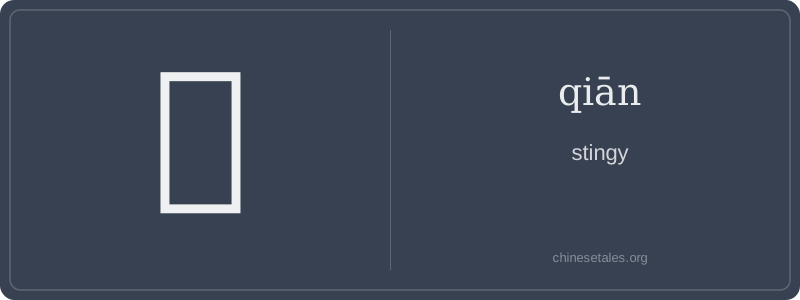
The earliest form of 慳 appears in Han dynasty clerical script, evolving from a combination of 心 (heart) and 坚 (jiān, 'firm/strong')—not as a pictograph but as a semantic-phonetic compound. The left side 忄 (a variant of 心) signals emotional or mental state; the right side 兼 (originally meaning 'to hold two things at once') was later stylized into 坚-like forms, then simplified to the modern 干 + 下 structure—but crucially, the phonetic component was always intended to suggest *jiān/qiān*, echoing the idea of 'holding tightly, refusing to let go.' Over centuries, strokes condensed: the top 'lid' (一), the crossed 'barrier' (十), and the lower 'ground' (下) fused visually into the current 10-stroke shape.
This visual tightening mirrors its semantic hardening: from early uses describing 'firm restraint' (in military texts) to Tang-era Buddhist sutras condemning '慳吝' as one of the Three Poisons’ offshoots—specifically, the stingy mind that hoards Dharma teachings or material aid. The poet Bai Juyi mocked officials who were 慳于赐 (stingy in granting favors), linking the character to power abuse. Its heart radical underscores that this isn’t about poverty—it’s about a constricted heart, a willful closing of the inner door to others.
Think of 悭 (qiān) as the Chinese cousin of Scrooge’s locked strongbox—not just 'stingy' but *morally charged stinginess*: hoarding where generosity is expected. Unlike neutral words like 小气 (xiǎoqì, 'cheap'), 悭 carries classical weight and literary sharpness, often implying a failure of virtue—like refusing alms to a beggar in a Tang poem or withholding knowledge from a sincere student. It’s almost never used casually among friends; you’d say 他很小气 for 'he’s cheap', but 悭 appears in essays, Buddhist sutras, or biting satire.
Grammatically, 悭 functions almost exclusively as a descriptive adjective before nouns (e.g., 慳吝之徒 'a miserly fellow') or in fixed four-character idioms (e.g., 慳吝守财). You won’t hear it in everyday speech like 'I’m being stingy today'—it’s too heavy, too judgmental. Learners sometimes mistakenly use it predicatively ('他很悭'), but native speakers avoid that; instead, they’ll say 他为人悭吝 or use 慳吝 as a compound. Also, it rarely stands alone—it needs reinforcement: 慳吝, 慳啬, or 慳贪.
Culturally, 慳 is steeped in Confucian and Buddhist ethics: generosity (施 shī) is a core virtue, so its opposite isn’t just frugal—it’s ethically suspect. A common mistake? Confusing it with 谦 (qiān, 'modest')—same sound, opposite moral valence! Pronouncing 慳 as qiān while thinking 'humble' leads to hilariously inappropriate compliments ('Your stinginess is admirable!'). And no, it’s not related to money characters like 财 or 钱—its heart is 忄 (heart/mind radical), signaling an inner failing, not a wallet size.