怄
Character Story & Explanation
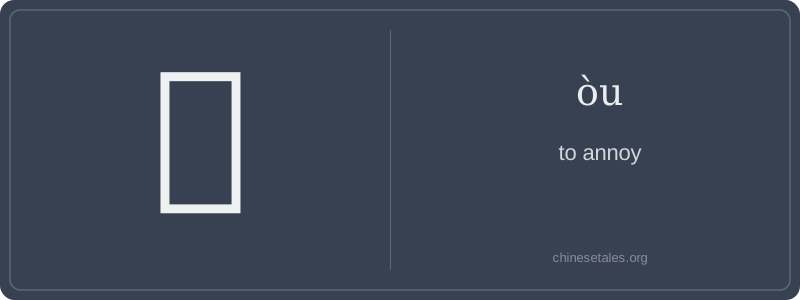
Oracle bone and bronze inscriptions show no direct precursor for 怄 — it’s a later creation, likely emerging in the Warring States period as a phono-semantic compound. The left side 忄 evolved from 心 (xīn, 'heart'), simplified over centuries from a pictograph of a heart with ventricles. The right side 右 began as a hand (又) pointing toward the mouth (口) in early forms — suggesting 'speaking out' or 'vocalizing discomfort'. By the Han dynasty, 右 stabilized into its current shape, losing the mouth but retaining the hand-like stroke, now purely phonetic. Visually, the seven strokes form a compact, slightly lopsided structure: three dots (忄) pulsing like a heartbeat, then four strokes (+一+口+丶) that look like a hand gripping a tight throat — a perfect visual echo of choked-off anger.
This character first appeared in texts like the *Shuōwén Jiězì* (121 CE) as an 'emotional obstruction', describing resentment so deep it impedes breath or speech. In Ming-Qing vernacular novels like *The Plum in the Golden Vase*, 怄 appears frequently in domestic scenes: wives 'òu qì' after petty slights, servants 'òu huǒ' at unfair treatment — always implying emotional labor, not mere irritation. Its enduring resonance comes from how precisely it captures the Chinese cultural value of restraint: the anger is real, even physical, but expression is muted, internalized, and therefore all the more potent.
Think of 怄 (òu) as the linguistic equivalent of a tiny, simmering volcano — not explosive rage, but that low-boil, gut-twisting irritation when someone cuts in line *again*, or your coffee order arrives wrong for the third time. It’s not just 'annoy' like 英语 'annoy'; it’s visceral, physical, almost nauseating: you feel it in your chest and throat. The 忄 (heart-mind radical) tells you this is deeply emotional, while the 右 (yòu, 'right') on the right isn’t about direction — it’s a phonetic clue (the ancient pronunciation was closer to *ou*), and its shape subtly echoes a clenched jaw or tightened throat.
Grammatically, 怄 is almost always used in compound verbs, never alone. You’ll see it in structures like 怄气 (òu qì — 'to sulk'), 怄火 (òu huǒ — 'to seethe'), or 怄人 (òu rén — 'to provoke someone'). It’s rarely transitive in modern speech; instead, it pairs with abstract nouns (qì, huǒ) or people (rén) to show the *target* or *state* of the annoyance. Learners often mistakenly try to use it like 气 (qì, 'anger') — e.g., *‘wǒ hěn 怄’* — but that’s unnatural; native speakers say *‘wǒ zài 怄 qì’* ('I’m sulking') or *‘tā ràng wǒ hěn 怄 huǒ’* ('He makes me furious').
Culturally, 怄 carries strong connotations of suppressed emotion — the kind you swallow rather than shout. It appears often in northern dialects and classical storytelling where characters endure injustice silently, their resentment building like steam in a kettle. A common mistake is overusing it in formal writing; it’s colloquial and slightly literary — you won’t find it in government notices or news headlines, but you’ll hear it in family arguments, sitcoms, and xiangsheng comedy. Its power lies in what’s *not* said: the silence after the slam of a door, the cold tea left untouched.