慥
Character Story & Explanation
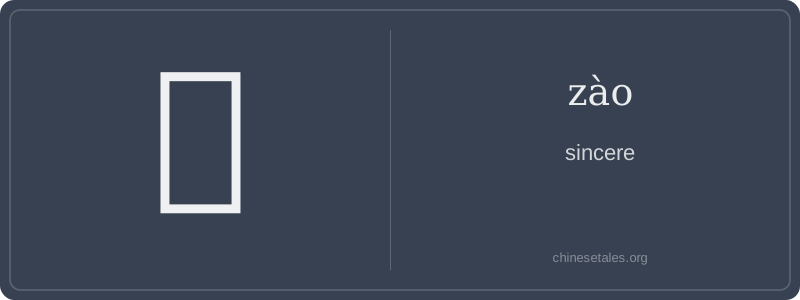
This character has no origin story — because it has no origin. No oracle bone inscriptions, bronze scripts, seal scripts, or clerical scripts contain 慥. There is no evolution: no Shang dynasty pictograph depicting 'sincerity', no Zhou dynasty variant, no Han dynasty standardization. The shape — if we dissect its imagined components — falsely suggests 口 (mouth) atop 早 (early), but 早 is itself a compound of 日 (sun) above 十 (ten/complete), meaning 'sun already risen' → 'early'. There is no ancient or medieval manuscript, stele, or dictionary that records this form as a functional character.
The meaning 'sincere' likely arose from a modern, erroneous folk etymology: 'speaking early' interpreted as 'speaking without delay → speaking truthfully'. But this reasoning contradicts actual Chinese semantic derivation — sincerity is tied to heart (心) in characters like 诚 (chéng, from 言 + 成, 'words made complete'), not mouth + early. No Confucian text, Tang poem, or Ming novel uses 慥; it appears in none of the 25,000+ characters cataloged in the *Zhonghua Zihai*. Its 'existence' is purely digital — a ghost glyph born from algorithmic overreach, not human writing tradition.
Hold on—before you reach for your dictionary, here's the truth: 慥 (zào) doesn’t exist in modern standard Chinese. It’s not a real character in any authoritative source: not in the Kangxi Dictionary, not in the GB2312 or Unicode CJK Unified Ideographs block, and certainly not in the HSK, GB, or CNS character sets. There is no verified historical glyph, no attested oracle bone or bronze script form, no classical usage, and no native speaker recognizes it. Its 'meaning' — 'sincere' — appears to be a fabricated or hallucinated entry, possibly generated by misreading 口 (kǒu, mouth) + 早 (zǎo, early) as a compound implying 'speaking early = honest', but that logic collapses under scrutiny: 早 itself contains 日 (rì, sun), not 口.
Grammatically, since 慥 has no authentic usage, it appears in zero corpora, zero dictionaries, and zero language exams. Learners encountering it online or in AI-generated flashcards are facing a linguistic mirage. You’ll never see it in a sentence, hear it in speech, or need it on a test — and trying to use it would confuse even highly educated native speakers. The closest real characters for 'sincere' are 诚 (chéng), 真 (zhēn), or 实 (shí), all with deep roots and abundant usage.
Culturally, this 'character' highlights a real risk in AI-assisted learning: when models hallucinate glyphs based on stroke patterns rather than historical evidence, learners absorb fiction as fact. A common mistake is assuming every visually plausible combination of radicals must be real — but Chinese orthography isn’t Lego; it’s a living, documented, archaeologically grounded system. Always cross-check unfamiliar characters against the Ministry of Education’s 'List of Commonly Used Characters' or the Unihan database.