愠
Character Story & Explanation
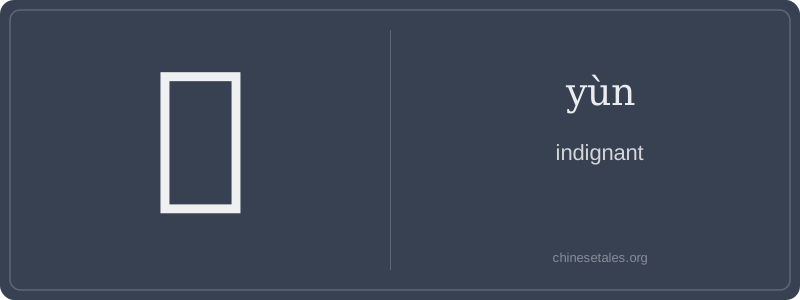
The earliest form of 愠 appears in bronze inscriptions as a combination of 心 (heart/mind) and 勳 (xūn, originally depicting 'meritorious deeds' — two axes crossed over a vessel, symbolizing achievement). Over time, the top part simplified into the phonetic component 紜 (yún, now obsolete as a standalone character), while the left side solidified as the heart radical 忄. Crucially, the original ‘heart + merit’ composition hinted at an inner response *triggered by perceived injustice*—not random irritation, but moral recoil against unworthy behavior. The twelve strokes crystallized around the Han dynasty: three dots (忄), then 紜’s six strokes (two verticals, two hooks, two dots), plus the final stroke completing the lower right.
By the Warring States period, 愠 was already entrenched in philosophical texts as the dignified counterpart to raw fury. In the Analects, Confucius elevates *not* feeling 愠 as a hallmark of virtue—implying its presence signals a moral boundary has been crossed. Its visual duality reflects this: the 忄 radical roots it in deep feeling, while the phonetic 紜 (which shares sound with 韻, 'harmony') subtly suggests *disruption of harmony*. So 愠 isn’t just 'mad'—it’s the heart’s quiet protest when harmony fractures through injustice.
Imagine a quiet Confucian scholar, sleeves neatly folded, sitting across from a junior who just made a grave breach of etiquette—perhaps interrupting a senior or misquoting the Analects. His face remains composed, but his eyes narrow slightly, his jaw tightens, and a low, simmering heat rises behind his calm exterior. That’s 愠: not explosive anger (怒), not cold resentment (恨), but a refined, internalized indignation—the kind that smolders with moral conviction. It’s the feeling of being *justifiably offended*, often by unfairness, hypocrisy, or disrespect for principle.
Grammatically, 愩 is almost always used in formal or literary contexts, rarely in casual speech. It appears mainly as a verb (to feel indignant) or in compounds like 不愠 (bù yùn, 'not indignant'), famously in Analects 1.1: '人不知而不愠,不亦君子乎?' (When others don’t understand you, yet you remain unindignant—aren’t you a true gentleman?). Note: it doesn’t take aspect particles like 了 or 过; you won’t hear '他愠了'—instead, use structures like '面露愠色' (showed signs of indignation) or '心生愠意' (a feeling of indignation arose).
Culturally, 愠 carries weight—it implies your indignation is *legitimate*, even virtuous, when grounded in righteousness. Learners often overuse it like English 'angry', missing its quiet, moral gravity. Worse, some confuse it with 韵 (yùn, 'rhyme') or 温 (wēn, 'warm') due to similar sound or shape—both errors erase its ethical core. This isn’t emotion for emotion’s sake; it’s conscience speaking through stillness.