慊
Character Story & Explanation
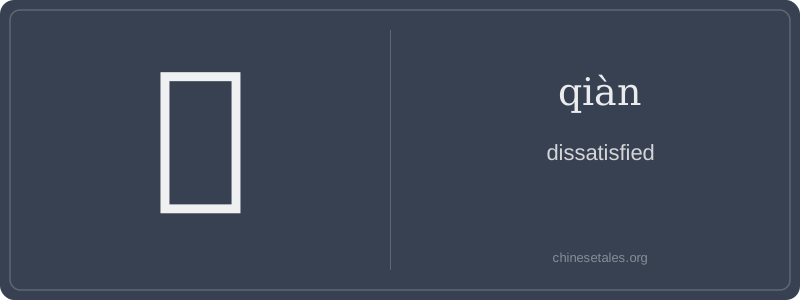
The earliest form of 慊 appears in Warring States bamboo slips as a composite glyph: left side a variant of 心 (heart/mind), right side a simplified version of 廌 (zhì), the mythical 'unicorn-judge' creature symbolizing impartial justice and moral discernment. Over centuries, the right component evolved — the horn and body of 廌 softened into the modern 欠 (qiàn), which originally depicted a person with mouth open, sighing or yearning. So visually, 慊 fused 'heart-mind' + 'sigh/yearning' — not just disappointment, but the *moral sigh* of something falling short of its rightful measure.
This fusion shaped its meaning: by Han dynasty texts like the *Shuowen Jiezi*, 慊 was defined as 'discontent arising from incompleteness' — specifically, when reciprocity or fairness is unfulfilled (e.g., a gift given without equal return, or duty performed without acknowledgment). Mencius (3A:4) uses it to describe the sage’s inner unease when benevolence remains unexpressed. The character never meant raw anger; it’s the refined, almost aesthetic discomfort of imbalance — like a scale tipped by a single grain. That original 'heart + sigh' visual logic still pulses beneath its modern strokes: thirteen strokes, each one a quiet reminder that dissatisfaction, in Chinese thought, begins not with complaint, but with calibrated perception.
At its heart, 慊 (qiàn) is the quiet ache of unmet expectation — not rage, not sorrow, but a low hum of dissatisfaction that lingers after something falls just short: a promise half-kept, a meal slightly underseasoned, a compliment that feels perfunctory. It’s an adjective, almost always used in formal or literary contexts — you won’t hear it in casual chat like 'I’m kinda annoyed' (that’s 生气 or 不爽). Instead, it appears in written reflections, essays, or classical-style prose, often paired with abstract nouns: 心中慊然 (xīn zhōng qiàn rán — 'a sense of inner dissatisfaction'), or 慊意未消 (qiàn yì wèi xiāo — 'the feeling of dissatisfaction hasn’t subsided').
Grammatically, 慊 rarely stands alone. It’s nearly always modified — by adverbs like 略 (slightly), 颇 (quite), or 深 (deeply) — or appears in set phrases like 慊然、慊意、不慊. Crucially, it’s *not* used predicatively like ‘I am dissatisfied’ — you wouldn’t say *‘我慊’*. Instead, you’d say ‘我心中颇慊’ or ‘对此事甚感不慊’. Learners often mistakenly treat it like a verb or colloquial adjective; it’s far more reserved and syntactically dependent.
Culturally, 慊 carries a subtle Confucian echo: it implies a standard has been breached — not by malice, but by failure to meet an internalized ideal of completeness or reciprocity. In classical texts, it appears in moral self-reflection (e.g., Mencius describing the sage who feels 慊 when virtue isn’t fully realized). Modern usage is rare and deliberate — choosing 慊 over 不满 signals literary awareness and emotional precision. Its rarity means encountering it feels like spotting a rare bird: brief, elegant, and quietly meaningful.