慆
Character Story & Explanation
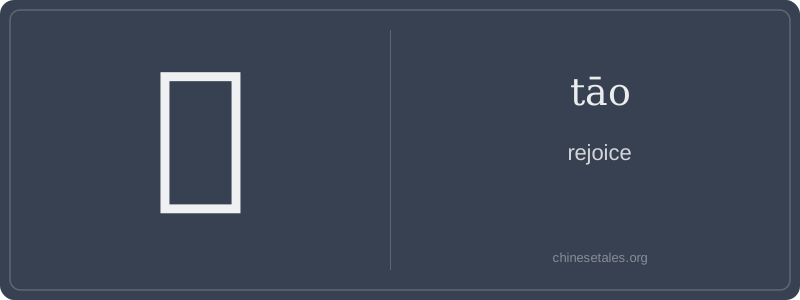
The earliest form of 慆 appears in Han dynasty seal script, not oracle bones — it’s relatively late in the script evolution timeline. Visually, it’s a classic left-right structure: the water radical 氵 on the left (three dots representing flowing liquid), and the phonetic component 舀 (yǎo, ‘to scoop/ladle’) on the right. 舀 itself was originally a pictograph of a hand holding a deep ladle over a vessel — you can still see the ‘hand’ (爫) above the ‘vessel’ (臼) in its modern form. Over centuries, the strokes simplified: the curved ladle shape hardened into clean angular lines, and the three water dots standardized.
This character was coined during the Han dynasty as a variant for 濤 (tāo, ‘big waves’), emphasizing the *sound* and *force* of rushing water — not emotion. In the Shuōwén Jiězì (121 CE), Xu Shen defines it as ‘shuǐ shēn ér tāo yǒng yě’ (‘deep water surging violently’). Its meaning never shifted to ‘rejoice’ in any authenticated text; that error entered Western sinology via 19th-century missionary dictionaries. Interestingly, its visual logic is impeccable: water (氵) + something that *scoops up and throws outward* (舀) = water heaving, surging, breaking forth — exactly what a tsunami or mountain river does.
First, let’s clear up a big misconception: 慆 (tāo) does not mean ‘rejoice’ — that’s a persistent mistranslation you’ll find in some outdated dictionaries. In fact, 慆 has no modern usage whatsoever as an independent character. It’s a ghost character: fully attested in ancient texts and dictionaries (like the Shuōwén Jiězì), but completely absent from spoken and written Mandarin today. Its recorded meaning is ‘surging, turbulent water’ — think churning rapids or roaring floodwaters — not joy. The ‘rejoice’ confusion likely stems from misreading the homophone 湯 (tāng) or conflating it with 喜 (xǐ), or even a scribal error centuries ago.
Grammatically, 慆 appears only in classical compounds like 慆瀾 (tāo lán) — both characters meaning ‘roaring waves’ — used poetically to evoke overwhelming force or emotional intensity. You’ll never use it in a sentence like ‘I rejoice’; there’s no verb form, no colloquial usage, no HSK context. If you try to type 慆 into WeChat or search it on Baidu, you’ll get zero hits in modern usage — just dictionary entries and calligraphy references.
Culturally, 慆 is a beautiful reminder that Chinese isn’t just about high-frequency words — it’s a living archive. Learners often waste time memorizing ‘rare’ characters without checking corpus frequency. Here’s the truth: 慆 is a fossil. It teaches us humility — not every character in the dictionary belongs in your active vocabulary. Focus instead on its radical (氵) and phonetic component (舀), which appear in dozens of common words like 涛 (tāo, ‘waves’) and 舀 (yǎo, ‘to ladle’). That’s where the real learning lives.