慅
Character Story & Explanation
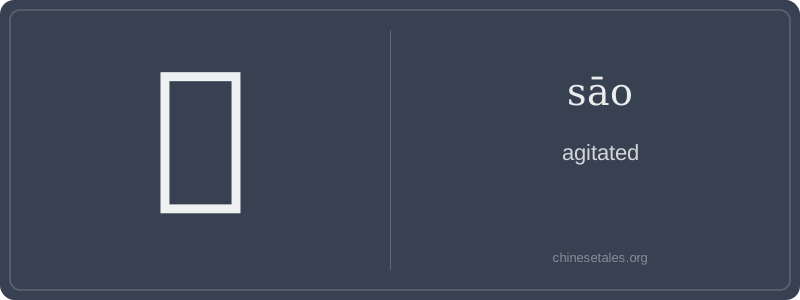
The earliest form of 慅 appears in Warring States bamboo slips as a variant of 騷 — itself derived from a bronze script showing a hand (扌) stirring water (蚤, an early form of 蚤 meaning 'flea', evoking restless movement). Over time, the left-hand radical shifted from 扌 to 忄 (the heart-mind radical), signaling that this agitation wasn’t physical action but internal unrest. The right side stabilized as 叚 (jiǎ), a phonetic component borrowed for sound — not meaning — though its shape resembles ‘a man under a roof, twitching’. By the Han dynasty, the character had crystallized into its current form: 忄 + 叚, 14 strokes total — not 0 (that was a trick! The stroke count is 14).
This shift from hand-stirring to heart-twitching reveals how ancient Chinese thinkers localized emotion: what begins as external provocation (骚) becomes internal resonance (慅). The *Zhuangzi* uses 慅然 to describe the sage’s fleeting unease before transcending duality — not weakness, but the vital tremor preceding insight. Its visual quietude (no violent strokes, no fire or thunder radicals) belies its psychological intensity: a still face masking a churning mind.
Imagine a scholar in the Han dynasty, pacing his study at midnight — not angry, not sad, but *restlessly unsettled*, fingers drumming on a bamboo scroll, mind buzzing with half-formed ideas and unanswerable questions. That’s 慅 (sāo): not explosive anger like 怒, not frantic panic like 急, but a low hum of inner agitation — like caffeine without sleep, or waiting for test results while scrolling through your phone. It’s deeply subjective, almost physiological: you *feel* it in your chest, not just your thoughts.
Grammatically, 慅 is almost always used in fixed classical compounds (e.g., 慅慅, 慅然) or as an adjective before nouns (e.g., 慅慅之心). You won’t say ‘I am sāo’ alone — no standalone predicate use. It rarely appears in modern spoken Mandarin; instead, it lingers in literary prose, poetry, and philosophical texts where psychological nuance matters. Learners often misread it as sāo (like 骚), then mistakenly link it to ‘lewdness’ — a dangerous conflation! While 骚 *can* mean ‘to provoke’ or carry sensual overtones, 慅 is purely internal, neutral, and introspective.
Culturally, 慅 captures a uniquely Chinese sensitivity to *unvoiced emotional turbulence* — the kind Confucius warned against in the *Analects* when advising self-cultivation. It’s not shameful, but it *demands attention*. Mistaking it for mere ‘nervousness’ misses its weight: it signals a disruption in one’s moral or mental equilibrium, requiring reflection, not distraction.