愮
Character Story & Explanation
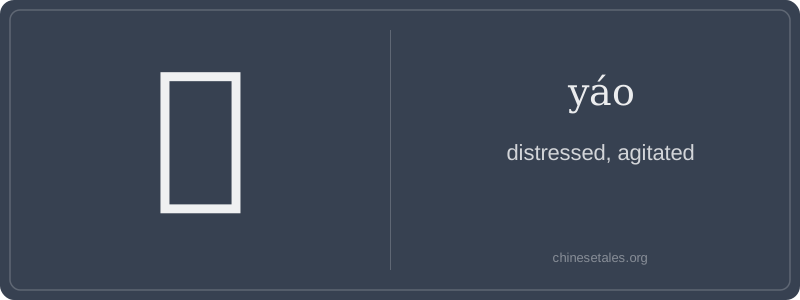
The earliest form of 愮 appears in Warring States bamboo slips as a combination of 心 (heart/mind radical) and 爻 (yáo)—a highly stylized, symmetrical glyph representing crossed divination rods used in ancient Yijing practice. Those rods weren’t just tools; they signified cosmic uncertainty, shifting patterns, and the anxiety of interpreting fate. Over centuries, the top 爻 simplified from two intersecting X-shaped strokes into the modern 爻 (which itself looks like tangled threads), while the 心 radical sank slightly and standardized—yet the visual tension between the restless top and the anchored heart remained central.
This origin directly shaped its meaning: not generic stress, but the specific mental agitation of confronting ambiguity—like reading omens, awaiting judgment, or facing irreversible choices. The Shuōwén Jiězì (121 CE) defines it as ‘heart shaken by doubt’, citing its use in the Zuǒ Zhuàn to describe Duke Wen of Jin’s anguish before battle. Later, poets like Du Fu used 愮 in lines about moral uncertainty—never trivial worries, always stakes that weighed on identity and duty. Even today, its shape whispers: ‘When the world’s signs cross and blur, the heart doesn’t race—it 愮.’
At its heart, 愮 captures a very Chinese kind of inner turbulence—not explosive anger or panic, but the quiet, heavy churn of unresolved worry: a knot in the chest when you’ve overthought a decision, or that restless unease before delivering difficult news. It’s deeply introspective, implying emotional weight that hasn’t yet spilled out as action—more 'heart-trembling' than 'shouting'. You’ll rarely hear it in casual speech; it lives in classical poetry, literary essays, and formal writing where psychological nuance matters.
Grammatically, 愮 is almost always used as a stative verb or adjective, typically in compound forms (e.g., 愮然, 愮悵) or after verbs like ‘見’ (to see) or ‘聞’ (to hear) to describe an observer’s visceral reaction: ‘見之愮然’ — ‘seeing it, one feels deeply agitated’. It doesn’t take aspect particles like 了 or 着, nor does it readily combine with degree adverbs like 很; instead, intensity comes from context or paired characters (e.g., 愮然失色). Learners often misapply it like 心慌 (‘nervous’) or 焦急 (‘anxious’), but 愮 carries no urgency—it’s contemplative, even melancholic.
Culturally, 愮 reflects a traditional value placed on emotional containment: the agitation isn’t dismissed, but named with precision—as if acknowledging the tremor makes it bearable. Modern usage is rare, so mistaking it for common synonyms can unintentionally sound archaic or overly literary. And crucially: it’s not used for physical discomfort (like pain or nausea)—that’s 惱 or 恶. Confusing it with those shifts the entire emotional register from soul-deep distress to surface irritation.