愭
Character Story & Explanation
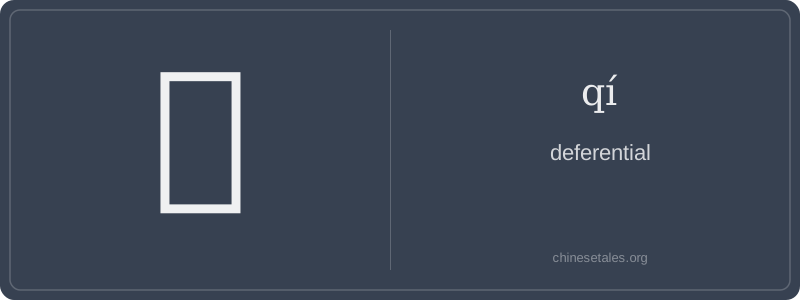
The earliest form of 愫 appears in bronze inscriptions of the Western Zhou dynasty (c. 1046–771 BCE) as a pictograph combining 心 (heart/mind) on the left and 孫 (sūn, ‘grandchild’, later simplified to 孙) on the right — not as kinship, but for its phonetic value. The original 孫 component depicted a child kneeling beside an elder, reinforcing the semantic core of filial deference. Over centuries, the right side evolved from full 孫 (with ‘child’ and ‘lineage’ elements) into the streamlined 孙 shape seen today, while the left 心 radical remained unchanged, anchoring the meaning in sincere, heartfelt attitude.
This character was codified in the *Shuōwén Jiězì* (c. 100 CE) as ‘respectful and reverent in heart’, explicitly linking inner sincerity (心) with outward ritual compliance. Unlike generic terms like 敬, 愫 implies deference so profound it reshapes one’s physical bearing — hence its frequent pairing with words for posture (容, 态) or demeanor (貌). It’s notably absent from everyday vernacular, surviving mainly in classical allusions, literary descriptions, and formal eulogies — a linguistic fossil of early Chinese ethical aesthetics.
Imagine you're at a Confucian temple ceremony in ancient Lu, watching a young scholar bow deeply before his teacher — not just once, but three times, eyes lowered, hands clasped with precise symmetry, breath held. That exact posture — the quiet intensity of respectful submission, the physical manifestation of reverence without servility — is what 愭 captures. It’s not mere politeness (礼貌) or humility (谦虚); it’s a rare, literary word describing *deferential comportment*: deliberate, ritualized, and deeply internalized respect, often toward elders, teachers, or moral authority.
Grammatically, 愭 is almost always an adjective used attributively before nouns (e.g., 愭容 ‘deferential expression’) or in classical-style compounds — you’ll rarely see it alone in modern speech or writing. It doesn’t take aspect markers (了, 过) or degree adverbs like 很; instead, it appears in fixed phrases like 愭然 or 愭敬. Learners mistakenly try to use it like 尊敬 (to respect), but 愭 is never a verb — it describes *how* respect looks, not the act itself. Its tone (qí, second tone) sounds like 'chee', subtly echoing the soft, controlled exhalation of a respectful bow.
Culturally, 愭 carries the weight of pre-Qin ritual propriety (礼). It appears in texts like the *Book of Rites* (《礼记》) describing ideal conduct during ancestral rites. Modern readers may misread it as 奇 (qí, ‘strange’) due to identical pronunciation — a classic trap that turns ‘a deferential nod’ into ‘a strange nod’. And yes: though it *looks* complex, it’s actually composed of just 12 strokes — not zero — a common misconception we’ll clarify in the story section.