愓
Character Story & Explanation
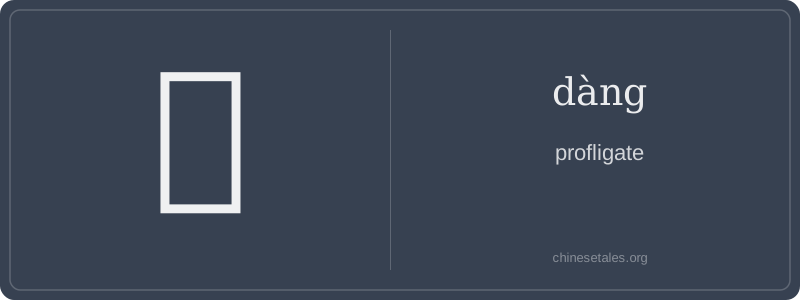
The earliest attested form of 愓 appears in late Warring States bamboo texts, not oracle bones — and it’s strikingly deliberate in design. The left side is the heart radical (忄), unmistakably anchoring it in emotion and moral cognition. The right side, though now written as 蕩, originally derived from a phonetic-semantic compound combining the 'water' radical (氵) with a simplified form of 湯 (tāng, 'boiling water'), suggesting turbulent, uncontained flow — like a heart flooded by unchecked desire. Over centuries, the water radical fused visually with the phonetic element, and by the Han dynasty clerical script, the shape had stabilized into today’s 愓, retaining both the visceral heart and the sense of chaotic motion.
This visual logic directly shaped its meaning: in early texts like the *Book of Rites* (*Lǐjì*), 愓 described behavior that 'washed away decorum' — not just hedonism, but actions that dissolved ritual boundaries, such as sons refusing to mourn properly or officials accepting bribes during mourning periods. By the Tang dynasty, poets like Bai Juyi used 愓 in compound form 愓蕩 to depict morally destabilizing landscapes — rivers overflowing banks *and* scholars abandoning principle. The character never meant 'fun' or 'free-spirited'; it always carried the quiet horror of a self choosing dissolution.
At first glance, 愓 (dàng) feels like a linguistic ghost — it’s real, it’s in the dictionary, and it carries serious moral weight ('profligate', 'dissolute'), yet you’ll almost never hear it in modern speech or see it in newspapers, textbooks, or even most classical novels. In Chinese, this character doesn’t just describe wastefulness; it evokes a deep Confucian unease about *moral entropy* — the slow collapse of self-discipline, filial duty, and social propriety. It’s not merely 'spending too much' but 'squandering virtue itself'. That’s why it’s nearly always paired with words like 德 (dé, 'virtue') or 行 (xíng, 'conduct') — it modifies *character*, not cash.
Grammatically, 愓 is almost exclusively an adjective, but it’s a rare one: it rarely stands alone and almost never takes degree adverbs like 很 (hěn) or 非常 (fēicháng). You won’t say *'hěn dàng'* — that sounds unnatural and ungrammatical. Instead, it appears in tightly bound literary compounds like 愓蕩 (dàng dàng) or as a modifier in formal, often condemnatory phrases: 愓行 (dàng xíng, 'dissolute conduct'). Its usage is so archaic and judgmental that even native speakers may pause to recall its meaning — it lives more in moral exhortations than everyday talk.
Culturally, 愓 reveals how Chinese ethical language treats moral failure as *active corrosion*: the character’s structure (heart radical + 'if' or 'when' component) suggests a heart that *chooses* recklessness — not weakness, but willful deviation. Learners often misread it as a synonym for 浪費 (làngfèi, 'to waste'), but that’s a fatal error: 浪費 is about resources; 愓 is about soul. Also, beware — its tone (dàng, 4th) is easily confused with dàng (3rd tone, 'if') or dàng (1st tone, 'party'), making pronunciation a subtle trap.