愒
Character Story & Explanation
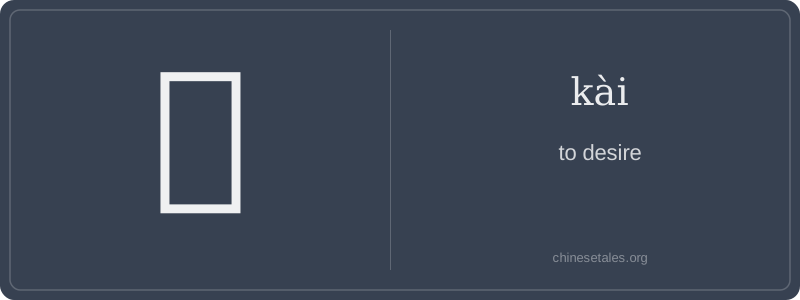
The earliest form of 愒 appears in bronze inscriptions as a compound: the heart radical (忄) on the left — signaling inner emotion — fused with a phonetic component that evolved into 卣 (yǒu), an ancient wine vessel used in ritual offerings. In oracle bone script, the right side resembled a stylized bronze vessel with handles and a lid — not just any container, but one reserved for sacred libations. Over centuries, the vessel simplified into the modern 卣 (though often misread as 由 or 甲), while the heart radical solidified into 忄, giving us today’s elegant, balanced structure: two components whispering about inner devotion and ritual intent.
This visual duality shaped its meaning: the vessel wasn’t for drinking, but for offering — so 愒 came to signify desire *directed upward*: toward ideals, sages, or Heaven itself. In the Book of Rites, it appears in passages praising those who ‘愒道如饥’ (desire the Way as if starving), linking physical craving to spiritual pursuit. Unlike generic verbs of wanting, 愒 always implies alignment — desire tempered by reverence. Its form reminds us: true longing isn’t grasping; it’s pouring yourself out, like wine into a sacred vessel.
Imagine you’re reading an ancient scroll in a quiet library, and your finger stops on the character 愒 — not because it’s common (it’s not!), but because it pulses with a rare, almost archaic hunger. It doesn’t mean casual 'want' like 想 or 爱; 愒 carries the weight of deep, visceral desire — the kind that stirs in classical poetry when a scholar longs for virtue, or a warrior yearns for glory. It’s poetic, elevated, and emotionally charged — think Shakespearean 'doth crave', not 'I want coffee'.
Grammatically, 愒 is almost exclusively literary and verb-only: it takes no objects directly in modern usage (no *愒 + noun*), and appears most often in set phrases or parallel constructions — like 愒德 (‘to thirst for virtue’) or in classical-style couplets. You won’t hear it in daily speech or see it on subway ads. Learners who try to substitute it for 要 or 想 will sound like they’ve stepped out of a Ming-dynasty opera — charming, but wildly out of place.
Culturally, 愒 whispers of Confucian self-cultivation: desire here isn’t indulgent — it’s disciplined longing, aligned with moral aspiration. A common mistake? Assuming it’s interchangeable with 慨 (kǎi, ‘to sigh’). But 愒 has no sigh — only silent, burning focus. Its rarity means even native speakers may pause before using it — not from ignorance, but reverence. It’s a character you *choose*, not one you default to.