愐
Character Story & Explanation
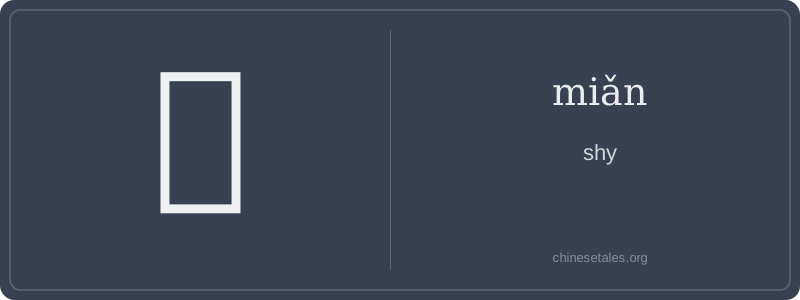
The earliest form of 愐 appears in Warring States bamboo texts as a composite glyph: left side was 心 (xīn, ‘heart/mind’), right side resembled 免 (miǎn, ‘to avoid/exempt’), but with an extra dot or stroke indicating intentionality — not mere avoidance, but *mindful withdrawal*. Over centuries, the right component simplified from a pictograph of a person turning away (head slightly bowed, hands folded) into the modern 免 shape, while the heart radical remained steadfast on the left — anchoring the meaning in inner disposition, not outward behavior.
This visual logic directly shaped its semantic evolution: from early texts like the *Book of Rites* (Lǐjì), where 愐 described ritual modesty (e.g., declining honors three times before accepting), to Tang poetry, where poets used 愐然 to evoke a scholar’s unassuming elegance. The character never meant fear or timidity — always *chosen* restraint rooted in respect. Even today, calligraphers emphasize the balance between the ‘heart’ and ‘avoidance’ components: neither dominates, symbolizing harmony between inner feeling and social grace.
First, let’s clear up a big misconception: 愐 doesn’t mean ‘shy’ in the Western psychological sense — it’s more precise and culturally grounded. It describes a quiet, respectful restraint: the kind of gentle hesitation you feel when meeting an elder for the first time, or when declining a generous offer without seeming rude. Think ‘modestly reserved’, not ‘socially anxious’. Its emotional tone is warm, dignified, and deeply relational — never negative or clinical.
Grammatically, 愐 is almost always used as a stative adjective *before* a noun (e.g., 愐态 miǎn tài, ‘shy demeanor’) or in fixed descriptive phrases like 愐然一笑 (miǎn rán yī xiào, ‘a modest, faint smile’). You won’t find it in predicate position alone (*‘He is 愐’ is unnatural); instead, it appears embedded in elegant, literary collocations — often in poetry, classical allusions, or formal speech. Learners mistakenly try to use it like 羞涩 (xiū sè), but 愐 carries no embarrassment — only graceful self-containment.
Culturally, 愐 reflects Confucian ideals of humility and harmonious restraint. It’s the quiet counterpart to overt confidence — valued especially in scholarly, artistic, or ceremonial contexts. A common mistake? Using it in casual modern speech (e.g., texting ‘I’m so 愐!’) — native speakers would gently correct you with 羞羞 or 害羞 instead. Reserve 愐 for moments where dignity, tradition, and subtle poise converge.