愊
Character Story & Explanation
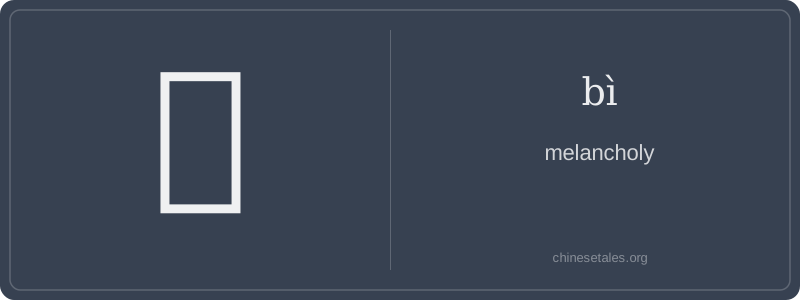
The earliest form of 愊 appears in Warring States bamboo slips as a compound: the ‘heart’ radical (忄) on the left, and 又 (yòu, ‘again’, originally a pictograph of a right hand) on the right — but crucially, 又 was later replaced by 壁 (bì, ‘wall’), likely due to phonetic borrowing. The original bronze script didn’t depict a wall, though — early variants show 心 + 襏 (a now-obsolete character meaning ‘to cover tightly’), suggesting containment, suppression. Over centuries, the right side simplified and stylized into 壁’s top-left corner (辟) fused with the ‘earth’ (土) base — yielding today’s 愊: 忄 + 辟 + 土, visually echoing ‘heart pressed beneath a dividing wall’.
This visual metaphor shaped its meaning: 愊 conveys melancholy that is *internalized, walled-in, and recurrent* — not expressed, but held. In the 3rd-century text *Guān Zhòng Zǐ*, it describes the silent sorrow of a loyal minister watching his ruler stray. By the Tang dynasty, poets like Li He used it to evoke the hollowness after passion fades — always tied to stillness and inwardness. Even today, its shape whispers ‘heart behind a barrier’: no outburst, just quiet accumulation.
At its heart, 愊 (bì) is a rare but evocative word for a deep, quiet melancholy — not the sharp sting of sorrow or the dramatic sweep of grief, but the low, resonant hum of lingering sadness, like mist settling over an empty courtyard at dusk. It’s a literary, almost poetic term: you won’t hear it in casual chats or HSK dialogues, but you’ll find it in classical poetry, Ming-Qing fiction, and modern essays aiming for lyrical gravity. Its emotional texture is introspective and dignified — never whiny, never chaotic.
Grammatically, 愊 functions almost exclusively as a *stative verb* or *adjectival noun*, often appearing in set phrases or after verbs like ‘feel’, ‘arise’, or ‘fill’. You’d rarely say ‘I am 愊’ alone; instead, it appears in constructions like ‘心生愊’ (xīn shēng bì — ‘a feeling of melancholy arises in the heart’) or ‘愊然不乐’ (bì rán bù lè — ‘melancholy and joyless’). Learners mistakenly treat it like a common adjective (e.g., *bì de*), but it has no attributive form — there’s no ‘bì de ren’ (‘a melancholy person’); that’s ungrammatical and sounds archaic to the point of parody.
Culturally, 愊 carries Confucian-tinged restraint: it’s the sorrow one bears silently, without outward display — the kind that accumulates in stillness, not tears. Modern writers use it deliberately to evoke classical resonance or psychological depth. A common pitfall? Confusing it with the more common 悲 (bēi, ‘sorrow’) or 忧 (yōu, ‘anxiety’) — but 愊 isn’t loud, urgent, or fearful. It’s the weight of memory, not the shock of loss. Think of it as the Chinese linguistic equivalent of ‘wistful’ — but with ancient bones and ink-stained sleeves.