愆
Character Story & Explanation
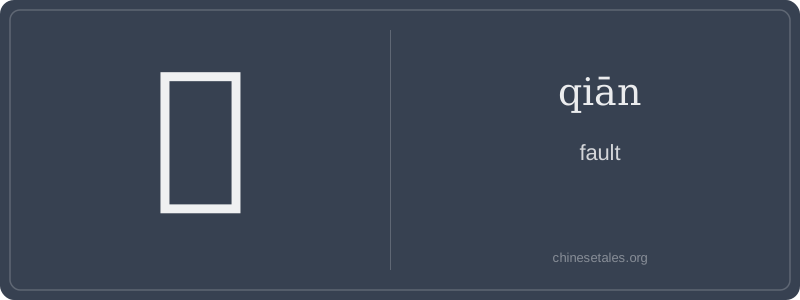
The earliest form of 愆 appears in late Warring States bamboo manuscripts—not oracle bones—but its structure reveals ancient logic. The left side, 衍 (yǎn), originally depicted water flowing *beyond* its channel (the three dots of 氵 + 行 without the two right strokes), symbolizing deviation or overflow. The right side, 心 (xīn), heart/mind, was added later to emphasize that this deviation was *intentional or morally charged*, not accidental. Over centuries, 衍 simplified into the top-left component (a bent line + three dots + horizontal stroke), while 心 remained intact at the bottom—giving us today’s 13-stroke structure: a visual metaphor of the heart straying from its proper course.
This evolution mirrors its semantic shift: from early meanings like ‘overflowing water’ (in bronze inscriptions) to ‘excess in conduct’ (Zhou ritual texts), then crystallizing in the *Book of Documents* as ‘violation of heavenly mandate’. By the Han dynasty, 愆 was firmly tied to ethical accountability—the heart’s failure to align with virtue (德). Its presence in Mencius’ critique of tyrants (*Mencius 1B.11*)—where he declares ‘bù rén zhě, qí xīn yǒu qiān’ (‘the un-benevolent have hearts with fault’)—shows how deeply the character fused physiology and morality: the heart itself becomes the site of culpability.
Think of 愆 (qiān) as Chinese literature’s version of the 'original sin' concept—not theological, but deeply moral and procedural. It doesn’t mean everyday 'mistake' like 错 (cuò) or error like 误 (wù); it’s a formal, weighty term for a *breach of duty*, a failure to uphold an expected standard—especially one enshrined in ritual, law, or filial obligation. In classical texts, it’s often paired with words like 罪 (zuì, crime) or 过 (guò, transgression), but carries sharper connotations of *moral dereliction*: not just 'I did wrong', but 'I failed in my role'. You’ll rarely hear it in casual speech—it lives in legal documents, Confucian commentaries, and solemn apologies.
Grammatically, 愆 functions almost exclusively as a noun ('fault', 'offense') or in fixed compounds—never as a verb. Learners sometimes wrongly try to say *‘qiān le’* (committed a fault), but that’s ungrammatical; instead, you’d say *fàn le yī gè qiān* (committed a fault) or use compound forms like 愆尤. It’s also frequently used in parallel constructions: *yǒu qiān wú huì* (‘having fault, no concealment’) — a classical idiom meaning ‘to confess faults openly’, still echoed in modern integrity pledges.
Culturally, 愆 is steeped in the idea of *accountability to principle*, not just consequence. A common learner trap is over-translating it as ‘sin’ or ‘guilt’—but unlike Western guilt, which centers on feeling, 愆 centers on *role-based failure*. Confucius himself used it in the *Analects* (16.1) to describe rulers who fail in benevolent governance: their 愆 isn’t personal weakness—it’s systemic dereliction. So if you see 愆 in a text, pause: someone didn’t just slip up—they broke a covenant.