愃
Character Story & Explanation
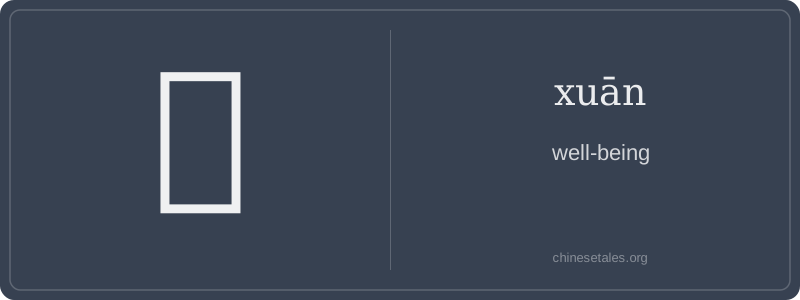
The earliest form of 愃 appears in late Warring States bamboo texts and Han dynasty seals — not oracle bone, but close! Its original shape combined 心 (xīn, ‘heart/mind’) on the left with 宣 (xuān, ‘to proclaim, to spread’) on the right. But here’s the magic: 宣 itself was originally a pictograph of a ‘window + roof + mouth’, suggesting sound radiating outward from an open space. So 愃 fused ‘heart’ with ‘resonant openness’ — visualizing inner clarity spreading like light through a sunlit window.
Over centuries, the right side simplified from 宣’s full form (宀 + 奐) to the modern 宣-like shape we see today — though it’s now considered a phonetic component (xuān), its origin is deeply semantic. In the Zhuangzi, 愃 appears in phrases like 愃然自得 (xuān rán zì dé), describing the sage’s effortless joy — not earned, but simply *present*, like sunlight on still water. The character’s evolution mirrors its meaning: from a concrete image of radiant openness → a symbol of innate, unforced well-being.
Let’s be honest: 愃 (xuān) isn’t your everyday character — it’s a quiet, elegant relic that whispers ‘well-being’ like a Daoist sage exhaling after meditation. It doesn’t shout health or happiness; it conveys a deep, settled harmony — physical ease *and* mental calm, often with overtones of auspiciousness or gentle prosperity. Think less ‘I’m fine!’ and more ‘My spirit rests lightly on my bones.’
Grammatically, 愃 is almost exclusively literary or poetic — you won’t hear it in daily chat or HSK textbooks. It functions as a stative adjective (e.g., 愃然 — xuān rán, ‘serenely at ease’) or appears in classical-style compounds. Crucially, it *never* stands alone as a verb or noun in modern speech. Learners sometimes misread it as ‘to declare’ (confusing it with 宣 xuān) or force it into colloquial sentences — but no, it belongs in calligraphy scrolls, Tang poetry footnotes, or the quiet dignity of a temple plaque.
Culturally, 愃 echoes ancient Chinese ideals of balance: not flashy success, but the untroubled flow of qi, the body’s effortless alignment with nature. Its rarity today makes it a linguistic ‘antique’ — treasured by scholars, poets, and calligraphers, yet nearly invisible to most native speakers under 60. A common mistake? Assuming it’s interchangeable with 安 (ān, ‘safe/peaceful’) — but while 安 is warm and grounded, 愃 feels lighter, airier, almost luminous. It’s well-being as a soft glow — not a fortress.