愀
Character Story & Explanation
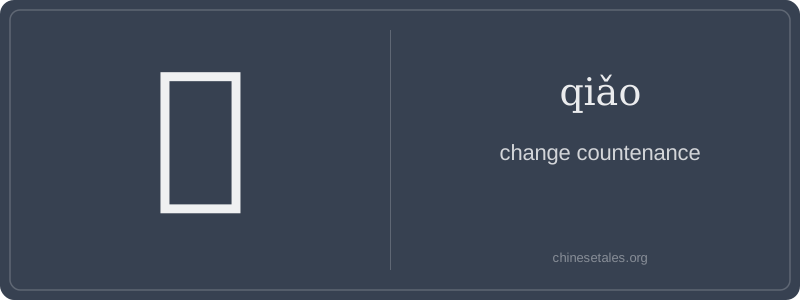
The earliest form of 愀 appears in bronze inscriptions as a combination of 心 (heart/mind) and 尤 (a pictograph of a limb with a swollen growth or deformity — suggesting 'abnormality' or 'disturbance'). Over time, 心 evolved into the left-side radical 忄 (‘heart-mind’), while 尤 retained its structure — two horizontal strokes, a vertical hook, then a final downward stroke. Crucially, the original 尤 didn’t mean ‘especially’ (its later semantic shift) but evoked something *visibly aberrant* — like a distorted joint or a jarring physical anomaly. So visually, 愀 was ‘heart-mind disturbed → face visibly warped’.
This visceral origin cemented its classical usage: in the Zuo Zhuan and Mencius, 愀 appears exclusively to describe the faces of sages or ministers whose inner turmoil surfaces physically — e.g., Mencius describing Duke Huan of Qi’s ministers who ‘looked grave and uneasy’ (愀然) upon hearing of moral failure. The character never meant ‘sadness’ outright; rather, it captured the precise micro-expression that betrayed deeper ethical distress — a linguistic scalpel for pre-Qin philosophers observing moral physiology in real time.
Think of 愀 (qiǎo) as Chinese literature’s version of a Hitchcockian close-up: not a full scream or tear, but that sudden, subtle tightening around the eyes and mouth when someone hears shocking news — the exact moment your face ‘falls’ before your brain catches up. It’s not about emotion in general, but the *visible, involuntary shift* in facial expression, especially one signaling disquiet, solemnity, or suppressed dismay. Unlike generic words like ‘sad’ (悲伤) or ‘angry’ (生气), 愀 zeroes in on the physical tell — like the flicker of a candle just before it gutters.
Grammatically, 愀 is almost always used as a verb in classical or literary contexts — rarely in spoken Mandarin — and appears either as a standalone verb (愀然) or as part of set phrases like 愀然不乐. You’ll almost never see it in isolation; it’s a ‘dress-shirt’ character: reserved for essays, historical dramas, or poetic narration. For example: ‘他愀然变色’ (He abruptly changed countenance) — notice how 愀 pairs naturally with verbs like 变色 (change color/complexion) or 不乐 (not joyful), acting as an intensifier of emotional gravity.
Culturally, this character carries Confucian weight: it’s the face you wear when propriety demands restraint — think of a scholar hearing bad tidings about his lord but suppressing outcry to maintain decorum. Learners often misread it as ‘serious’ or ‘stern’, missing its core nuance of *transient, reactive change*. Also, beware — it’s tone 3 (qiǎo), not qiāo or qiào, and its 12 strokes include two delicate ‘dot-and-hook’ elements (the last two strokes of 忄 + the final stroke of 尤) that beginners frequently smudge into a blob.