惺
Character Story & Explanation
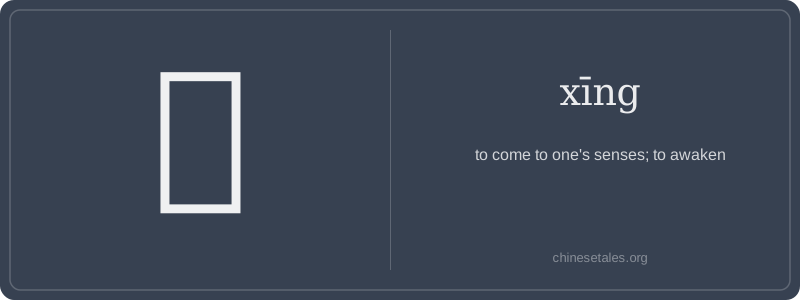
The earliest form of 惺 isn’t found in oracle bones, but in early seal script, where it emerged as a compound of 忄 (heart-mind radical) and 星 (xīng, star). Wait — star? Yes! Not literally celestial, but phonetically borrowed: 星 provided the sound *xīng*, while 忄 anchored the meaning in consciousness. Visually, the left side 忄 evolved from the ancient heart pictograph ❤️→⺗→忄; the right side 星 simplified from a complex bronze-era glyph showing three stars (彡) above 'life' (生) — later streamlined to 日 + 生. Over centuries, strokes tightened: the top of 星 flattened, the horizontal lines merged, and the whole character settled into its crisp, balanced 12-stroke modern form.
This phonetic-semantic marriage was brilliant: stars are constant, luminous, and guide travelers — much like awakened insight guiding moral conduct. In the *Analects* and later Chan Buddhist texts, 惺 appears in phrases like '惺然不昧' (xīng rán bù mèi) — 'brightly awake, never clouded' — describing the alert, unobscured mind of the sage. The character’s visual duality (star + heart) thus became a metaphor: enlightenment isn’t distant or divine; it’s the heart recognizing its own light — a quietly revolutionary idea in pre-modern China.
At its heart, 惺 (xīng) is the quiet *click* of consciousness returning — like waking from deep sleep, snapping out of a trance, or suddenly grasping a truth you’d been blind to. It’s not just physical awakening (that’s 醒 xǐng); it’s the mental and moral 'coming to', often with a tinge of remorse, clarity, or self-reckoning. Think of it as the moment your conscience pokes you in the ribs: 'Wait — what did I just do?' That’s why it rarely stands alone; it almost always appears in compounds like 惺惺相惜 (xīng xīng xiāng xī), where two sharp-minded people recognize each other’s integrity.
Grammatically, 惺 is never used as a verb on its own — you won’t say 'I 惺' like 'I wake up'. Instead, it functions exclusively within fixed, literary expressions. Learners sometimes mistakenly treat it like 醒 (to awaken) and try to use it transitively ('He 惺 his mistake'), but that’s ungrammatical. Its usage is tightly bound to classical rhythm and parallelism — mostly in four-character idioms or poetic couplets. It’s also tone-sensitive: while both 惺 and 醒 mean 'awaken', 惺 carries a higher register, an almost philosophical weight — you'd find it in Tang poetry or Ming-dynasty moral essays, not in a weather report.
Culturally, 惺 is deeply tied to Confucian self-cultivation — the idea that true virtue arises not from rules, but from inner awakening. A common learner trap is misreading it as 星 (xīng, star) due to identical pronunciation and similar stroke count. But while 星 glitters outwardly, 惺 shines inwardly: it’s the mind’s sudden illumination, not celestial light. Also, note the radical 忄 (heart-mind): this isn’t about eyes opening — it’s about the *xin* (heart-mind) becoming lucid.