惶
Character Story & Explanation
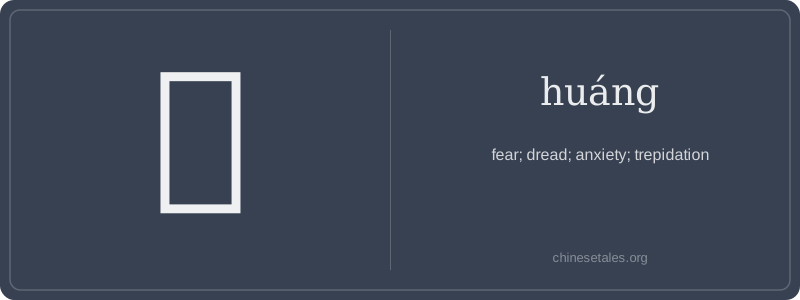
The earliest form of 惶 appears in Warring States bamboo slips, not oracle bones — and it’s a masterclass in visual psychology. Its left side 忄 (the 'heart' radical) was originally 心, drawn as a stylized, pulsing organ. The right side, 皇, began as a pictograph of a royal headdress with flowing ribbons ( + 白 + 王), symbolizing authority — but here, it’s repurposed phonetically *and* semantically: imagine the heart ‘under the weight of imperial expectation’, beating wildly beneath ceremonial regalia. Over centuries, the headdress simplified into 皇’s modern shape — three horizontal strokes (representing ribbons), a vertical line (the crown rod), and the bottom ‘王’ (king) — all now abstracted, yet still whispering ‘authority-induced tremor’.
This duality — heart + royal pressure — crystallized in early texts. In the Zuo Zhuan, ministers are described as 惶然失色 ('turning pale with惶') upon hearing unjust decrees, their fear rooted in ethical distress, not physical danger. By the Tang dynasty, poets like Du Fu used 惶 to capture existential unease — ‘mountains shift, stars waver, my spirit 惶’ — linking cosmic instability to inner fragility. Visually, the 12 strokes even mimic a quickened pulse: the three dots of 忄 (3), the three horizontals of 皇’s top (3), the vertical stroke (1), the crossbar (1), and the final ‘王’ (4 strokes) — a heartbeat counting down from calm to crisis.
Think of 惶 (huáng) as the Chinese equivalent of that stomach-dropping lurch you feel when you realize you’ve walked into the wrong meeting — not full-blown panic, but a sharp, fluttery dread mixed with self-consciousness. It’s not raw terror (that’s 怕 or 恐), nor is it clinical anxiety (焦虑); 惶 carries a literary, almost poetic weight — a trembling inner unrest, often triggered by uncertainty, moral unease, or social misstep. You’ll rarely hear it in casual speech; it lives in essays, classical allusions, and solemn declarations.
Grammatically, 惶 is almost never used alone. It pairs tightly: 惶恐 (huángkǒng, 'trembling fear'), 惶惑 (huánghuò, 'bewildered anxiety'), or appears in fixed four-character idioms like 惶惶不安 (huánghuáng bù’ān, 'restlessly uneasy'). Learners mistakenly try to use it like a verb ('I huáng') — but it functions only as an adjective or in compounds. Its tone (second tone, rising) subtly echoes its meaning: a lift, then a waver — just like the breath before a confession.
Culturally, 惶 evokes Confucian sensitivity to propriety: the scholar who feels 惶 at a breach of ritual, or the official who grows 惶 when his conscience clashes with orders. A common error is over-translating it as 'scared' — missing its moral texture. Also, don’t confuse it with 煌 (huáng, 'brilliant') — same sound, opposite energy! One makes your heart race; the other makes your eyes widen in awe.