惴
Character Story & Explanation
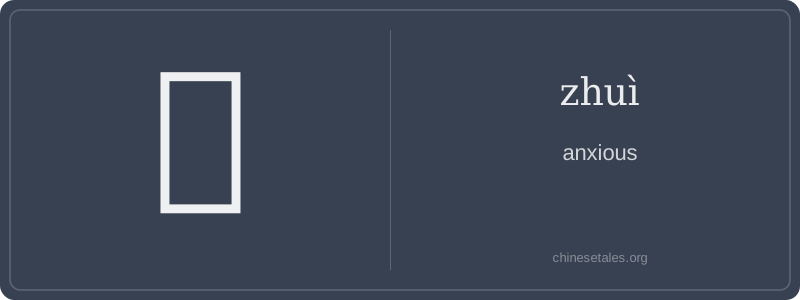
The earliest form of 惴 appears in Warring States bamboo slips as a character combining 心 (heart) on the left and 端 (duān, upright/precise) on the right — but over centuries, 端 simplified into 而 (ér, and/but) plus 丶 (a dot), then further stylized into the modern 右 (yòu) shape we see today. The left side remained 忄 (the ‘heart’ radical), signaling emotion, while the right side evolved from a depiction of a person standing still but tense — knees slightly bent, shoulders drawn in — mirroring the physical posture of someone bracing for bad news.
This visual tension became semantic: by the Han dynasty, 惴 appeared in texts like the *Huainanzi*, describing ministers ‘心惴而色变’ (xīn zhuì ér sè biàn — ‘hearts anxious and faces changed’), showing how inner unease manifests outwardly. Its use peaked in Tang-Song poetry, where poets chose 惴 over plainer synonyms to evoke refined psychological nuance — not panic, but the hush before thunder. Even today, its structure whispers that true anxiety lives not in the mind alone, but in the silent tremor of the heart.
At its heart, 惴 (zhuì) captures a very specific kind of anxiety — not the broad, modern ‘stress’ of daily life, but a quiet, internal, almost physical trembling in the chest before something consequential: an exam result, a confession, a judge’s verdict. It’s visceral and literary, rarely used in casual speech today; you’ll find it more often in classical texts, formal writing, or poetic descriptions where emotional gravity matters.
Grammatically, 惴 is almost always an adjective — but unlike most adjectives, it doesn’t take 很 or other degree adverbs. You won’t say *很惴*; instead, it appears in fixed phrases like 惴惴不安 (zhuì zhuì bù ān), or after subject-predicate structures like ‘他心中惴’ (tā xīn zhōng zhuì — ‘His heart is anxious’). It can also function as a stative verb: ‘她惴了一夜’ (tā zhuì le yī yè — ‘She was anxious all night’), though this usage is rare and highly literary.
Culturally, 惴 carries a Confucian weight — it reflects the self-awareness and moral vigilance expected of a cultivated person facing ethical uncertainty. Learners often misread it as ‘zhuī’ (chase) or confuse it with 坠 (zhuì, to fall), missing its emotional core. And crucially: it’s not interchangeable with 怕 (pà, to fear) or 焦虑 (jiāo lǜ, anxiety) — those imply external threat or chronic worry; 惴 is inward, anticipatory, and deeply personal.