惝
Character Story & Explanation
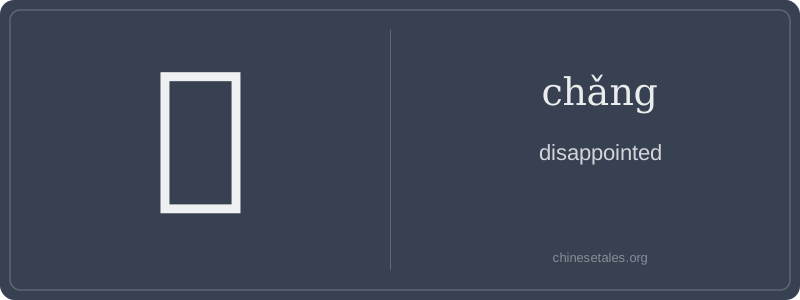
The earliest form of 惝 appears in Han dynasty clerical script, evolving from the radical 忄 (heart/mind) on the left and a right component derived from 尚 (shàng, 'still, yet, above'), which itself combines 丨 (a vertical line symbolizing uprightness) and 小 (xiǎo, 'small') under a roof-like top. Over centuries, the right side simplified: the roof became ⺷ (a decorative frame), the 小 compressed into two dots and a horizontal stroke, and the vertical line merged into the final downward stroke — yielding today’s elegant 11-stroke structure. Visually, it’s a heart carrying something elevated yet unattainable — a perfect glyph for longing that curdles into quiet dismay.
This visual logic shaped its meaning: by the Tang dynasty, 惝 appeared in poetry describing the mental state after sudden disillusionment — Li Bai used 惝怳 in 'Dreaming of Tianmu Mountain' to depict the jarring return from ecstasy to emptiness. Unlike 怅, which evokes forward-looking sorrow, 惝 connotes backward-looking disorientation: the moment your inner map dissolves because the landmark you trusted vanished. Its pairing with 怳 (huǎng, 'confused, vague') cemented this duality — together, they name the liminal fog between memory and present reality.
At its heart, 惝 (chǎng) captures a very Chinese kind of disappointment—not the explosive anger of 'I’m furious!' nor the passive resignation of 'whatever'—but that quiet, hollow ache when expectation collapses inward, like a deflated balloon you didn’t even notice was full. It’s introspective, almost dignified in its sadness: the scholar who fails the imperial exams after decades of study; the parent whose child abandons tradition; the poet gazing at an empty pavilion where friends once gathered. This isn’t just 'disappointed'—it’s disappointment seasoned with time, loss of face, and lingering reverence for what *should have been*.
Grammatically, 惝 is almost never used alone. It appears almost exclusively in fixed literary compounds like 惝恍 (chǎng huǎng, 'dazed and disoriented') or 惝怳 (chǎng huǎng, variant spelling), always paired, never as a standalone verb or adjective. You won’t say 'I feel chǎng' — instead, you might write '他神情惝恍' (tā shénqíng chǎng huǎng, 'His expression was dazed and disoriented'). Learners often mistakenly try to use it like 失望 (shīwàng), but 惝 carries no colloquial weight—it’s reserved for classical allusion, poetic description, or solemn narration.
Culturally, 惝 reveals how deeply Chinese aesthetics value emotional resonance over raw intensity. Its soft, flowing strokes mirror the feeling it names: not jagged despair, but a gentle, spreading fog of letdown. A common learner trap? Assuming it’s interchangeable with 怅 (chàng, 'melancholy')—but while 怅 leans into yearning, 惝 leans into cognitive dissonance: the mind stumbling over a gap between reality and deep-rooted hope. Using it casually risks sounding archaic or unintentionally theatrical.