惛
Character Story & Explanation
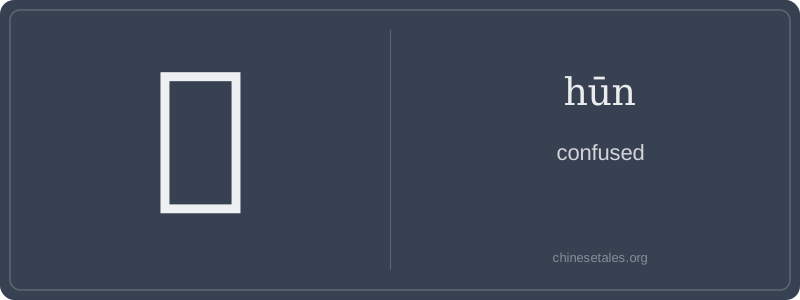
The earliest trace of 惛 appears not in oracle bones, but in Warring States bamboo slips, where it evolved from the character 昏 (hūn, ‘dusk’) — which *did* begin as a pictograph: the sun (日) sinking below the horizon (氐, later simplified to 民-like shape). That original image — light vanishing — became a metaphor for mental dimming. Over centuries, the ‘sun’ component was replaced with the heart-mind radical 忄 to emphasize interiority, while the right side solidified into 享 (xiǎng), not for ‘enjoyment’, but as a phonetic loan — its ancient pronunciation closely matched hūn. The 11 strokes now encode both sound (享) and meaning (忄): a mind ‘sinking’ like dusk.
This semantic shift is brilliantly documented in the 3rd-century medical classic *Treatise on Cold Damage* (Shāng Hán Lùn), where 惛 describes patients whose consciousness fades during febrile illness — ‘神志惛’ (clouded spirit). Later, in Tang dynasty poetry, it evokes melancholic introspection: Li Bai wrote of ‘惛然不知身在何处’ (dazed, unaware even of his own whereabouts). Visually, the character’s compact, downward-leaning structure — with 忄 on the left and 享’s layered horizontal strokes drooping rightward — mirrors the sensation it names: mental gravity pulling thought down into haze.
At its core, 惛 (hūn) isn’t just ‘confused’ in the casual, modern sense — it’s a deep, almost physical fog in the mind: dazed, disoriented, mentally clouded, often from fatigue, illness, or shock. Think less 'I forgot my password' and more 'I just woke up from anesthesia and can’t tell if it’s morning or midnight'. It’s a literary and formal word — you’ll rarely hear it in daily chatter (hence its absence from HSK), but it appears powerfully in novels, medical reports, and classical-style essays to evoke vulnerability or cognitive collapse.
Grammatically, 惛 is almost always used as a stative adjective, usually before a noun (e.g., 惛沉沉的天空 — 'gloomy, heavy sky') or in reduplicated form 惛惛 (hūn hūn) to intensify the haze — like 'dully dazed' or 'in a stupor'. Crucially, it *cannot* be used predicatively without support: you wouldn’t say *‘他很惛’* alone; instead, you’d say *‘他显得惛沉’* (He appears dazed) or *‘神志惛’* (mental faculties clouded). Learners often overextend it like ‘confused’ in English, but 惛 implies *passive mental obstruction*, not active uncertainty — no ‘I’m confused about the math’ here.
Culturally, 惛 carries subtle weight in traditional Chinese medicine (TCM) and Daoist texts, where mental clarity (清) and cloudiness (惛) reflect the balance of qi and spirit (shén). Misusing it as a synonym for 迷糊 (míhu) or 困惑 (kùnhuò) misses its somber, physiological tone — it’s closer to ‘stupefied’ than ‘puzzled’. Also beware: its radical 忄 (heart-mind) signals this is *not* a visual or environmental fog (like 雾 wù), but an *internal* one — the mind itself has gone misty.