惙
Character Story & Explanation
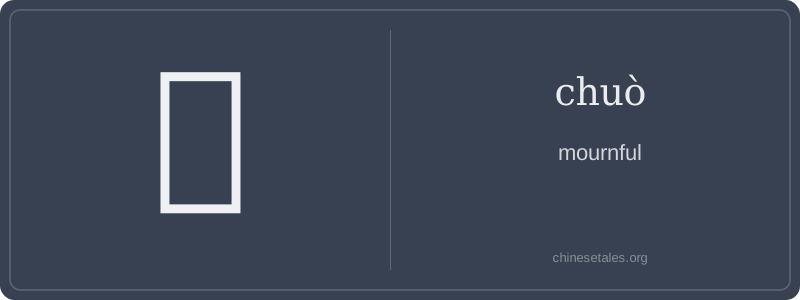
The earliest form of 惙 appears in seal script as a combination of 忄 (the ‘heart-mind’ radical, indicating emotional state) and 兌 (duì), which originally depicted an open mouth in a gesture of speaking or sighing — but crucially, in ancient phonetic loan usage, 兌 also carried connotations of ‘diminishing’, ‘subsiding’, or ‘withering’. Over time, the right side simplified from the full 兌 (8 strokes) to its modern 4-stroke form, while the left 忄 retained its three-dot-heart shape — together forming an 11-stroke character whose very structure whispers ‘heart + fading’.
This visual logic directly shaped its meaning: by the Warring States period, 惙 described a spirit that had ‘subsided’ — not vanished, but sunk low, drained of upward energy. The Shuōwén Jiězì (c. 100 CE) defines it as ‘heart exhausted, spirit sinking’ (心敝而神惙). In Tang dynasty poetry, poets used 惙然 to depict the hush after parting — not tears, but the sudden weight in the chest when the friend’s carriage disappears down the road. Its form doesn’t shout; it settles — and so does its meaning.
At its heart, 惙 (chuò) isn’t just ‘mournful’ — it’s the quiet, heavy stillness *after* grief has settled in, like fog clinging to a gravesite at dawn. It evokes a deep, inward dejection: not loud wailing, but a hollowed-out weariness, a sagging of spirit. You’ll almost never hear it in casual speech — it’s literary, poetic, often archaic. Think classical poetry or solemn historical prose, where emotional restraint is itself expressive.
Grammatically, 惙 functions as an adjective — but rarely stands alone. It usually appears in compound words (like 惙然 or 惙然若失) or modifies nouns with 的 (e.g., 惙然之色). Learners sometimes try to use it like modern adjectives such as 悲伤 or 难过 — but that feels jarringly stiff or even comically overwrought. It doesn’t take degree adverbs (very, extremely), nor does it pair with 了 or 过; its power lies in its austerity and fixed collocations.
Culturally, 惙 reflects the Confucian-tinged aesthetic of dignified sorrow — emotion channeled into quietude, not eruption. Mistake alert: Don’t confuse it with 悴 (cuì, ‘haggard’) or 惆 (chóu, ‘melancholy’) — those imply visible strain or lingering thought, while 惙 suggests a deeper, more passive collapse of vitality. Its rarity today makes it a linguistic fossil — beautiful, precise, and deliberately reserved for moments when silence speaks loudest.