惔
Character Story & Explanation
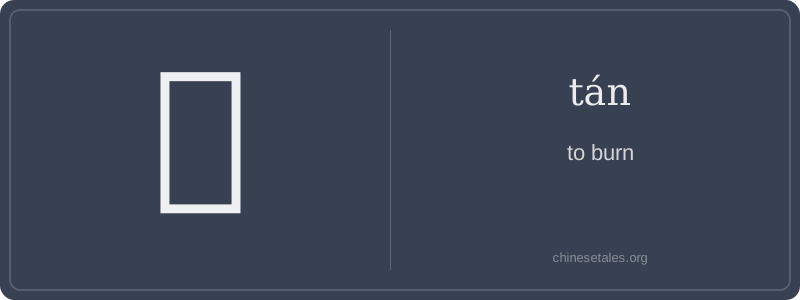
The earliest form of 惔 appears in bronze inscriptions as a combination of 火 (fire) on the left and 亶 (dǎn, originally depicting a full grain container, later phonetic) on the right. In oracle bone script, fire was drawn as flickering flames — three jagged lines rising from a base — while 亶 evolved from a pictograph of a granary with overflowing grain, symbolizing abundance and sincerity. Over centuries, the fire radical simplified into its modern four-dot form (灬) at the bottom, and 亶 condensed into the upper-right structure you see today: a compact, weighty component suggesting both sound and semantic depth.
This evolution mirrors its meaning shift: from literal combustion (Zhou dynasty bronze inscriptions describing ritual fires) to metaphorical burning — especially emotional or spiritual intensity. In the Book of Rites, 惔 appears in descriptions of sacrificial rites where offerings were 'burned thoroughly' (惔尽), implying total devotion. Later, in Tang poetry, it described inner turmoil — 'a heart burned by longing' — cementing its role as the verb for *consummate* heat: not surface flame, but core incandescence. Its visual heaviness — dense strokes, grounded structure — mirrors how it conveys irreversible, thorough transformation.
Think of 惔 (tán) not as a common verb like 'burn' in English — more like the Latin root 'combust-' or the chemical term 'exothermic': precise, technical, and almost fossilized in modern speech. It doesn’t mean 'to set on fire' casually (that’s 烧 shāo); instead, it evokes slow, intense, often internal combustion — like embers glowing deep in ash, or passion smoldering beneath restraint. You’ll rarely hear it in spoken Mandarin today; it lives in classical texts, poetic metaphors, and compound words where 'heat + transformation' is central.
Grammatically, 惔 functions almost exclusively as a verb in literary or archaic contexts — never as a standalone command ('Burn it!') but embedded in phrases like 惔尽 (tán jìn, 'burn to exhaustion') or 惔心 (tán xīn, 'scorch the heart'). Unlike shāo, which takes objects directly (我烧水 wǒ shāo shuǐ), 惔 usually appears with complements or in fixed four-character idioms (e.g., 惔膏继晷 tán gāo jì guǐ — 'burn oil and keep watch through night', meaning study relentlessly). Learners mistakenly swap it for 烧 or 焚, but doing so sounds like quoting Confucius at a barbecue — technically possible, culturally jarring.
Culturally, 惔 carries a quiet gravity: it’s the burn of sacrifice, not accident; of willpower, not wildfire. Its rarity makes it a linguistic heirloom — like finding 'whilst' in a modern text. Mispronouncing it as tān (first tone) or confusing its radical (火) with 灬 (four dots, as in 热) is common — but remember: this character breathes heat *from within*, not flame from above.