惓
Character Story & Explanation
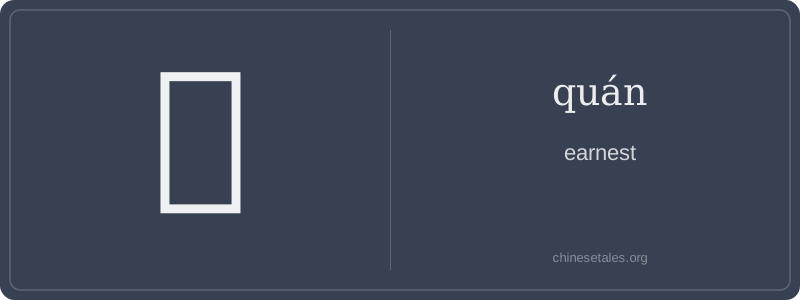
The earliest form of 惓 appears in Han dynasty clerical script, not oracle bones — it’s a relatively late-comer among characters. Its left side, 忄 (the ‘heart-mind’ radical), signals emotional domain, while the right side, 卷 (juǎn), originally depicted a scroll being rolled up — symbolizing careful containment and deliberate unfolding. Over centuries, 卷 simplified from a complex pictograph of hand + scroll + binding cord into today’s streamlined shape. The full character thus visually merges ‘heart’ and ‘carefully rolled scroll’: a mind holding intention with meticulous, reverent attention — not hasty, not casual, but coiled with purpose.
This imagery shaped its meaning: by the Tang dynasty, 惓 appeared in texts like the *Wen Xuan* (Literary Selections) to describe ministers’ ‘unfaltering loyalty’ — their devotion as carefully preserved and repeatedly unrolled, like a sacred text. In Song dynasty Neo-Confucian writings, it evolved to signify the inner sincerity required for self-cultivation: not performative virtue, but quiet, persistent alignment of thought and action. The character’s very structure — 11 strokes balancing restraint (the compact 忄) and elaboration (the flowing 卷) — mirrors its semantic core: earnestness as disciplined emotional fidelity.
Think of 惓 (quán) as the Chinese equivalent of 'earnest' — not the polite-but-distant kind you'd use in a cover letter, but the deeply felt, slightly old-fashioned earnestness of Atticus Finch explaining justice to Scout: quiet, unwavering, morally weighted. In Chinese, it conveys sincere dedication — not just effort, but *heartfelt* commitment, often with a tinge of solemnity or even melancholy. It’s rarely used alone; instead, it appears almost exclusively in literary or formal compounds like 惓惓 (quán quán) or 惓切 (quán qiè), where reduplication or pairing intensifies its gravity.
Grammatically, 惓 functions only as an adjective — never a verb or noun — and almost never modifies nouns directly in modern speech. You won’t hear ‘a 惓 person’; rather, you’ll encounter phrases like ‘with 惓惓 concern’ or ‘expressed 惓切 hopes’. A classic mistake is misreading it as quán (‘complete’) — but this isn’t about wholeness; it’s about *emotional density*. Learners often overuse it trying to sound ‘literary’, but native speakers reserve it for moments of moral urgency — think diplomatic communiqués, memorial inscriptions, or classical poetry translations.
Culturally, 惓 carries Confucian resonance: it evokes the sincerity (诚 chéng) that underpins ritual propriety (礼 lǐ). Its rarity today makes it feel like a linguistic heirloom — still recognized, occasionally deployed for rhetorical weight, but no longer part of daily lexical breath. Unlike common synonyms like 真诚 (zhēnchéng) or 诚恳 (chéngkěn), 惓 implies continuity of feeling — not a burst of honesty, but sustained, unswerving devotion.