惎
Character Story & Explanation
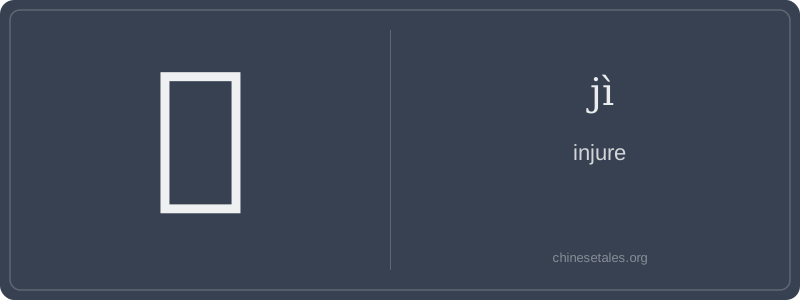
The earliest form of 惎 appears in Warring States bamboo slips as a composite ideograph: left side (a variant of 心, 'heart/mind'), right side 旣 (jì, 'already completed', originally depicting a person turning away after eating). Crucially, 旣 itself contains the 'eaten' radical (皀) and 'turned back' (旡), suggesting finality and withdrawal—but here, repurposed. Over centuries, the heart radical simplified to 忄, and 旣 lost its top horizontal stroke, becoming the modern right component. The full character thus visually merges 'mind' + 'completed action'—not passive suffering, but active, resolved harm.
This visual logic shaped its meaning: 惎 never meant 'to be hurt,' but 'to harbor hostile intent so firmly that action follows.' In the Zuo Zhuan, it describes ministers who 'inwardly 惎 the duke’s reforms'—their resentment wasn’t fleeting anger, but a settled, operationalized hostility. By the Han dynasty, it acquired legal force: 'to 惎 another’s life' implied premeditated endangerment, distinct from manslaughter. Even today, its shape whispers its essence: the heart radical demands psychological depth; the 旣 component insists on irrevocable consequence—no half-measures, no accidents.
Think of 惎 (jì) as Chinese’s version of the word 'wound'—not just physical injury, but a sharp, deliberate, almost surgical harm that cuts deeper than skin: it implies intention, violation, and moral gravity. Unlike common injury verbs like shāng (伤) or hài (害), 惎 carries classical weight—it’s the kind of verb you’d find in a Ming dynasty legal document or a Tang poem describing betrayal, not a stubbed toe. It’s rarely used alone today; instead, it appears almost exclusively in literary compounds or formal registers, like a Latin root in English ('lacerate' vs. 'cut').
Grammatically, 惎 is a transitive verb requiring a direct object and strong agency: you *must* specify who harms whom, and often *how*. You wouldn’t say 'He was injured' with 惎—you’d say 'He 惎 his rival’s reputation' (他惎其对手的声誉). It never takes aspect particles like 了 or 过 in modern usage, and attempting to use it colloquially (e.g., 'I jì my finger') will sound bizarrely archaic—or unintentionally poetic. Learners often misread it as jī (like 鸡) or confuse it with 疾 (jí, 'illness'), both phonetically and visually perilous.
Culturally, 惎 is a linguistic fossil—a character preserved not for daily utility, but for rhetorical precision in ethics, law, and classical criticism. Its rarity makes it a subtle status marker: spotting it in a text signals literary sophistication; using it correctly suggests deep exposure to pre-modern sources. Modern writers deploy it like a scalpel—to evoke cold malice, calculated sabotage, or the quiet devastation of slander—not blunt-force trauma. That’s why it’s absent from HSK: it’s not about frequency, but about semantic density.