惌
Character Story & Explanation
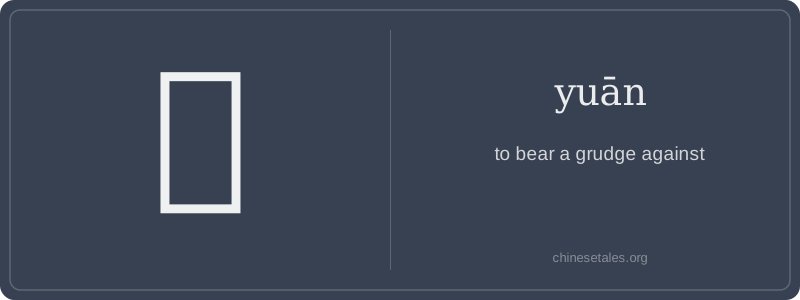
The earliest form of 惌 appears in Warring States bamboo slips as a compound ideograph: the left side was 忄 (heart radical), and the right was 夂 (zhǐ), an ancient pictograph of a foot turning back — symbolizing lingering, returning thoughts. Over time, 夂 evolved into the top-right component 元 (yuán), phonetically approximating yuān while visually reinforcing ‘origin’ or ‘source’ — as if the grudge originates deep within the heart and refuses to move on. By the Han dynasty, the character stabilized into its current shape: 忄 + 元, with the dot above 元 added later for clarity.
This visual logic mirrors its semantic evolution: early texts like the *Zuo Zhuan* use 惌 to describe aristocrats who ‘held ancestral grievances’ — not petty squabbles, but inherited feuds tied to honor and lineage. In Tang dynasty poetry, it appears in lines like ‘惌结于胸,终不可解’ (the resentment knots in the chest, never to be untied), emphasizing its visceral, bodily permanence. Unlike generic anger characters, 惌 was always about *memory-as-weapon*: the heart doesn’t forget — it archives.
Imagine a quiet teahouse in Suzhou, where two elderly scholars sit across from each other — not speaking, not pouring tea, just staring into their cups. The air is thick with silence that isn’t peaceful; it’s charged, heavy, like unspoken accusations suspended in steam. That’s 惌 (yuān): not just ‘anger’ or ‘dislike’, but the slow, deliberate, deeply personal act of *holding onto resentment* — often for years, sometimes silently, always intentionally. It’s the kind of grudge you don’t shout about; you *curate*. This character implies agency, duration, and moral weight — it’s never used for fleeting irritation.
Grammatically, 惌 is almost exclusively a verb and appears in formal or literary contexts — rarely in casual speech or modern media. It takes the structure ‘对…惌’ (duì… yuān), meaning ‘to bear a grudge against [someone/something]’. You won’t say ‘我惌你’ (I resent you) — that’s unnatural and overly blunt. Instead: ‘他对当年被撤职一事始终惌恨在心’ (He has harbored resentment over his dismissal years ago). Note how it pairs naturally with 心 (heart/mind) or 恨 (hatred) — it’s rarely standalone.
Culturally, 惌 carries Confucian gravity: it suggests a rupture in relational harmony (hé) that hasn’t been ritually repaired — no apology accepted, no face restored. Learners often misapply it like English ‘resent’, missing its solemnity and historical resonance. Using 惌 in texting or slang would sound like quoting classical poetry at a pizza party — technically correct, profoundly awkward.