惆
Character Story & Explanation
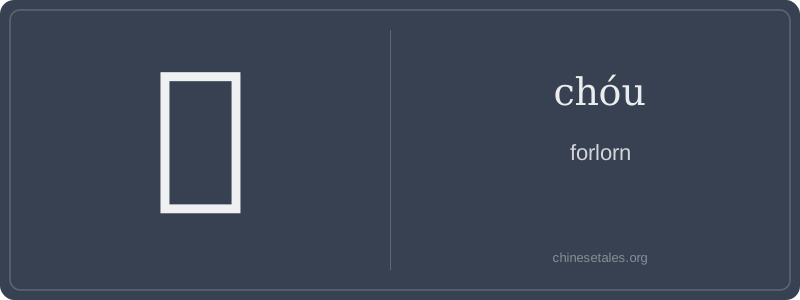
The earliest trace of 惆 appears in seal script (c. 3rd century BCE), where it fused two elements: the heart-mind radical 忄 on the left—already standard for emotions—and the phonetic component 周 (zhōu) on the right. 周 originally depicted a field enclosed by a boundary (冂 + 吉), symbolizing completeness or cyclical return—but here, it served purely to signal pronunciation. Over centuries, clerical script simplified the strokes: the top of 周 lost its ornate curves, the middle horizontal lines tightened, and the final stroke of 忄 became a clean, descending dot. By the Song dynasty, the modern form stabilized—11 precise strokes, with the heart radical subtly leaning rightward, as if weighted by sorrow.
This character didn’t exist in oracle bone inscriptions; it emerged later as Chinese emotional vocabulary grew more nuanced. By the Han dynasty, 惆 was already paired with 怅 in the famous phrase 惆怅—appearing in the *Chu Ci* (Songs of Chu), where Qu Yuan wrote of 'chóu chàng xī bù dé zhì' (forlorn and frustrated, unable to fulfill his purpose). The visual pairing—heart + 'zhou'—mirrors its semantic role: an emotion so complete, so self-contained, it circles back on itself like the character 周 suggests. It’s not outward despair, but inward resonance—a sorrow that hums at its own frequency.
Chóu (惆) is that quiet, lingering ache—the kind you feel watching rain blur the streetlights at midnight. It’s not raw grief or sharp anger, but a soft, heavy forlornness: wistful, unresolved, deeply introspective. Think of someone gazing out a train window, remembering what’s gone—not sobbing, but sighing inwardly. In Chinese, 惆 never stands alone; it’s always paired—almost like it needs emotional backup. You’ll only ever see it in compounds like 惆怅 (chóu chàng) or 惆惋 (chóu wǎn). Trying to say 'I am chóu' is as unnatural as saying 'I am melancholy' without context in English.
Grammatically, it functions exclusively as the first syllable in disyllabic emotional nouns or adjectives. It’s never a verb, never a standalone predicate, and never used predicatively after 是 or 很. Learners often mistakenly treat it like 忧 (yōu, 'to worry') or 悲 (bēi, 'sad'), but 惆 has zero independent grammatical life—it’s a poetic half-note, not a full chord. Its presence instantly elevates register: you’d find it in classical poetry or literary essays, not WeChat chats or weather reports.
Culturally, 惆 carries the hush of literati sensibility—the Tang dynasty scholar’s quiet sorrow over fading spring, or the Ming poet’s gentle regret for unrequited longing. Mistake it for modern colloquial sadness, and you’ll sound oddly archaic or even theatrical. Also beware: its radical 忄 (heart-mind) signals deep interiority, but its right side (周) isn’t about 'surrounding'—it’s phonetic, lending the 'chóu' sound. So don’t read meaning into 周 here; that’s a classic learner trap.