惄
Character Story & Explanation
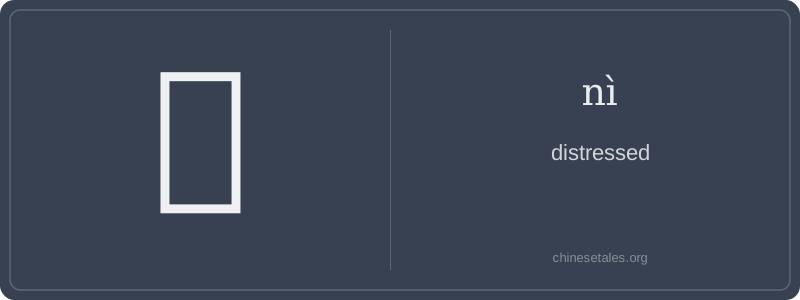
The earliest form of 惄 appears in bronze inscriptions (c. 1000 BCE) as a heart radical (忄) paired with a complex glyph resembling a mouth pierced by two thorns (朿). Oracle bone precursors show a simplified heart + ‘prickling’ element — suggesting physical constriction mapped onto emotion. Over centuries, the thorn cluster evolved into the modern 朿 (cì), while 口 (mouth) remained clear, and 忄 stabilized as the left-hand emotional indicator. By the Han dynasty, the structure was standardized: three distinct components working together — heart, mouth, thorn — a visceral image of sorrow that chokes expression.
This visual logic shaped its meaning: not just sadness, but *suppressed* sorrow — the kind you swallow rather than shout. It appears in the *Classic of Poetry* (Shījīng), where a loyal minister writes ‘中心惄焉’ (zhōng xīn nì yān — ‘my heart is distressed within’), capturing quiet moral anguish. Later, in Tang dynasty poetry, it resurfaces in elegies, always paired with restrained verbs: 惄然、惄如、惄焉. Its rarity today isn’t decline — it’s preservation: like a ceremonial sword kept in its scabbard, drawn only when gravity demands it.
Think of 惄 (nì) not as a common word you’ll hear in daily chat, but as a poetic whisper — the kind of word that appears in classical poetry or solemn inscriptions when someone is deeply, inwardly distressed: heart-heavy, soul-tightened, almost speechless with sorrow. It’s not panic or anger; it’s quiet, profound anguish — like reading an old letter from a lost love and feeling your chest constrict. The character carries weight, not noise.
Grammatically, 惄 is almost always used as a standalone adjective or in fixed literary compounds (like 惄然), never as a verb or noun on its own. You won’t say ‘I 惄’ — instead, you’ll see 惄然 (nì rán), meaning ‘distressedly’ or ‘with visible sorrow’, modifying a verb: 惄然长叹 (nì rán cháng tàn — ‘sighed deeply in distress’). It rarely appears in modern spoken Mandarin — if you try to use it at a café in Beijing, your barista might blink politely — but it’s alive in essays, historical dramas, and calligraphy scrolls.
Culturally, 惄 belongs to the ‘emotional vocabulary of restraint’: unlike 痛 (tòng, ‘pain’) or 悲 (bēi, ‘grief’), it implies dignified suffering — the kind Confucian scholars described when duty clashed with desire. Learners often misread it as 忄+咢 (a common error), but the right side is actually 朿 (cì, ‘thorn’) + 口 (kǒu, ‘mouth’) — a visual metaphor: ‘a thorn in the mouth’ = unable to speak freely due to inner torment. Don’t force it into casual speech — save it for writing that needs gravitas.