悾
Character Story & Explanation
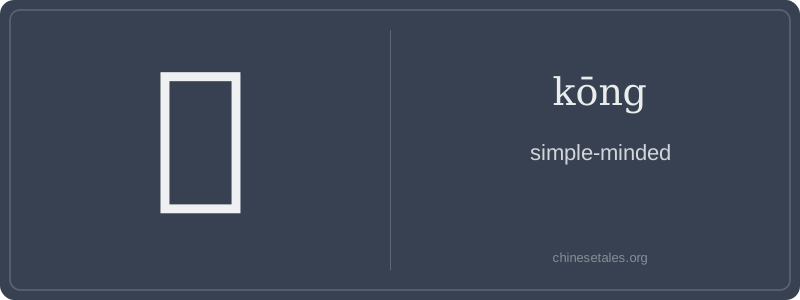
The character 悾 first appeared in late Warring States bamboo texts, not oracle bones — its form is actually a clever semantic-phonetic compound: the left side 忄 (the 'heart-mind' radical) signals emotional/cognitive meaning, while the right side 空 (kōng, 'empty') serves both as sound clue and conceptual anchor. Visually, it’s a minimalist upgrade of 空: just add three dots (the abbreviated 心 radical) to the left of 空, turning abstract emptiness into *mental* emptiness — a mind so uncluttered it’s practically echoless.
Its meaning crystallized during the Han dynasty in texts like the Shuōwén Jiězì, where it was defined as 'sì xīn wú zá niàn' (a heart/mind without杂念, mixed thoughts). By the Ming-Qing vernacular novels, 悾 acquired gentle irony — describing characters like the loyal but dim servant in Water Margin whose literal-mindedness causes comic chaos. The visual pun is perfect: same sound as 空, same 'emptiness', but narrowed to the human psyche — not void, but vacancy of cunning.
Think of 悾 (kōng) as the Chinese equivalent of calling someone 'a blank slate with blinkers on' — not stupid, but charmingly, almost endearingly devoid of guile or complexity. It describes a person who’s transparently simple-minded: uncalculating, unsophisticated, perhaps even naively trusting — like a character from a pastoral fable who believes clouds are made of cotton candy. Unlike the neutral 'simple' (jiǎndān), 悾 carries gentle condescension, often affectionate, never cruel.
Grammatically, it’s almost exclusively an adjective modifying people or their minds, and it’s nearly always used in literary or ironic registers — you won’t hear it in casual WeChat chats. It appears most naturally after the particle de (的), as in 'tā zhè ge rén hěn kōng de' (he’s such a simple-minded person). Crucially, it’s NOT used predicatively without 的 — saying *'tā hěn kōng' sounds jarringly archaic or poetic, like quoting Tang dynasty verse at a coffee shop.
Culturally, 悾 evokes Confucian-adjacent ideals of purity of heart — think of Mencius’ belief that human nature is inherently good and uncluttered. Learners often mistakenly equate it with 空 (kōng, 'empty'), but that’s a classic trap: 空 is philosophical (emptiness in Buddhism) or physical (an empty room), while 悾 is exclusively psychological and human-centered. Also, beware tone — kōng (first tone) ≠ kǒng (third tone, 'fear')!