悻
Character Story & Explanation
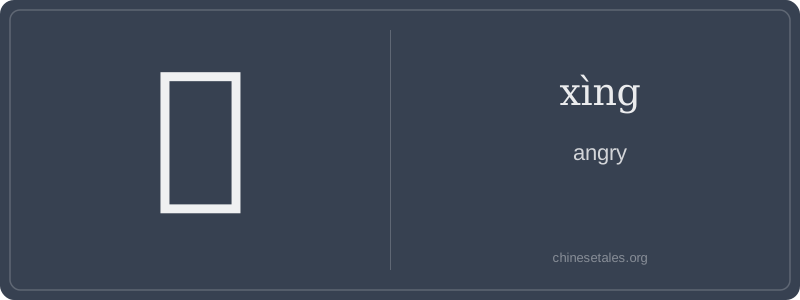
The earliest form of 悻 appears in Warring States bamboo slips, where it combines the heart radical 忄 (originally written as 心 at the bottom) with the phonetic component 幸 (xìng). But here’s the twist: 幸 wasn’t just a sound clue — it was a loaded symbol. In oracle bone script, 幸 depicted a shackle or fetter ( + 土), representing forced labor or punishment. When fused with 忄, the character visually encoded ‘a heart bound by injustice’ — not rage, but the heavy, constricted feeling of being wronged without recourse.
Over centuries, the shackle shape in 幸 softened into its modern form, and 悻 stabilized as an 11-stroke character with 忄 on the left and 幸 on the right. Classical usage cemented its tone: Confucius’s Analects (17.2) uses 悻悻 to describe disciples who depart ‘sullenly’ after failing to persuade their master — revealing how early this word captured the subtle social tension of losing face while preserving principle. The character never became colloquial because its meaning required nuance no slang could carry: it’s the anger you swallow, then let your posture speak for you.
Think of 悻 (xìng) as the Chinese equivalent of that tightly coiled spring in a vintage pocket watch — not explosive like 'angry' in English, but simmering, restrained, and deeply personal. It describes a quiet, inward-facing resentment: the kind you feel when someone breaks a promise you quietly held sacred, or when injustice is politely ignored. Unlike common words like 生气 (shēngqì) — which is broad and situational — 悻 carries literary weight and emotional precision: it’s the anger of dignity wounded, not temper flared.
Grammatically, 悻 almost never stands alone. You won’t say *‘I am xìng’* — it’s strictly adjectival and requires intensifiers or compounds: 不悻 (bù xìng, ‘unresentful’), 悻悻 (xìng xìng, reduplicated for emphasis — ‘sullenly, with visible resentment’), or paired with verbs like ‘露出’ (lùchū, ‘to show’) or ‘而退’ (ér tuì, ‘and withdraw’). Its usage is mostly literary or formal; you’ll find it in classical texts, modern essays, or solemn speeches — never in casual WeChat chats.
Learners often misread 悻 as ‘happy’ because of its visual similarity to 幸 (xìng, ‘happiness’), or overuse it thinking it’s a neutral synonym for ‘angry’. Big mistake: using 悻 in place of 生气 can sound archaic, judgmental, or even sarcastic — like calling someone’s frustration ‘a profound moral grievance’. Also, note the radical 忄 (heart-mind): this isn’t surface irritation — it’s heart-deep, identity-adjacent dissatisfaction.