悸
Character Story & Explanation
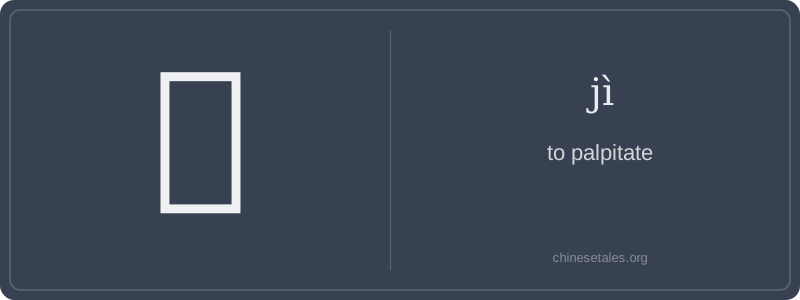
The earliest form of 悸 appears in Warring States bamboo slips as a variant of 心 (xīn, ‘heart’) with a phonetic component added for pronunciation. Its modern shape crystallized by the Han dynasty: left side 忄 (the ‘heart-mind’ radical, a compressed 心), right side 夋 (qūn), which originally depicted a coiling dragon or serpent — not literally, but symbolically evoking twisting, surging movement. Over centuries, 夋 simplified from a sinuous curve into today’s clean, angular strokes: 九 + 冂 + 一 — yet that ancient sense of coiled energy remains embedded in the right half.
This visual duality — heart + coiling motion — perfectly captures its meaning: the heart not beating steadily, but *twisting*, *lurching*, *surging* under emotional pressure. In the Shuōwén Jiězì (121 CE), it’s defined as ‘heart trembling due to fright’, and Li Bai used it in a line about stars seeming to shiver — extending the physical tremor into cosmic awe. The character doesn’t just describe biology; it maps emotion onto physiology, making the invisible inner quake legible in ink.
At its heart, 悸 (jì) isn’t just ‘palpitate’ — it’s the visceral, involuntary flutter of the heart when emotion hits hard: fear before a speech, awe at a mountain vista, or sudden grief. It’s not clinical (like 心跳加快); it’s poetic and psychological — the heart *reacting*, not just beating. You’ll almost never see it alone; it lives in compounds like 心悸 or 惊悸, always paired with another character to specify the trigger or sensation.
Grammatically, 悸 is a noun or verb root but never stands solo as a predicate verb (you wouldn’t say ‘我悸’). Instead, it appears in subject position (心悸很常见) or after verbs like 感到, 出现, or 引起. Learners often wrongly treat it like a standalone action verb — but it’s more like ‘a tremor’ than ‘to tremble’. Think of it as a *noun-verb hybrid*: the palpitation itself, with emotional gravity baked in.
Culturally, 悸 carries classical elegance — you’ll find it in Tang poetry describing moonlit longing or Ming drama where a maiden’s heart ‘quivers’ at first sight. Modern usage leans medical (心悸 = ‘palpitations’), but poets and novelists still use it to evoke raw, wordless inner shock. A common mistake? Confusing it with 忆 (yì, ‘to remember’) — same sound, totally different pulse: one is memory, the other is heartbeat gone rogue.