悷
Character Story & Explanation
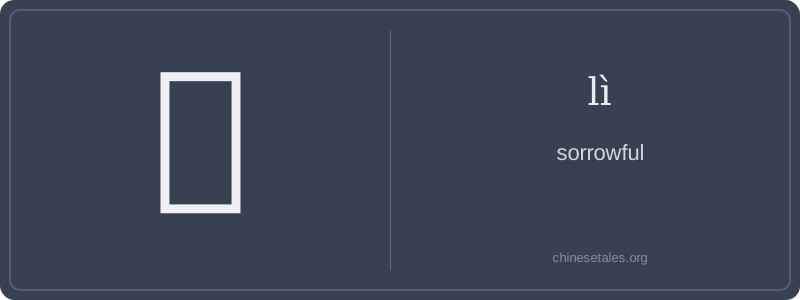
The earliest form of 悷 appears in bronze inscriptions as a compound: the heart radical (忄) on the left — representing emotion — fused with 立 (lì, 'to stand') on the right, which originally depicted a person upright, feet planted firmly. Over centuries, 立 simplified from a full figure with legs and head into its modern three-stroke form, while 忄 evolved from the full heart pictograph (心) into its left-side variant. Crucially, this wasn’t just 'heart + stand' as a random combo — ancient scribes used 立 not only for sound (it’s a phonetic component) but also for semantic nuance: standing still implies stillness of spirit, unmoving grief — sorrow so profound it arrests motion itself.
This visual logic endured: in the Shuōwén Jiězì (121 CE), Xu Shen defined 悷 as ‘sorrow that makes one stand motionless’ — a definition echoing Confucian ideals of measured, internalized emotion. In Tang dynasty poetry, poets like Du Fu used 悷 in lines describing silent, stoic mourning — never wailing, always centered. Even today, when you see 悷 in a classical text, you’re not just reading ‘sadness’ — you’re witnessing a 2,000-year-old aesthetic choice: sorrow rendered not as collapse, but as unwavering, rooted stillness.
凓 is a rare, literary character meaning 'sorrowful' or 'grieved' — not the everyday sadness of 伤心 (shāng xīn), but a deep, quiet, almost classical ache, like the hush after a funeral or the weight in a Tang poem’s final line. It’s not used in spoken Mandarin at all; you’ll only meet it in pre-modern texts, poetry, or highly stylized prose. Its emotional texture is restrained, dignified, and inward — think tears held back, not sobbed out.
Grammatically, 悷 functions as an adjective, almost always in fixed, two-character compounds like 悷然 (lì rán) or 悷怆 (lì chuàng). You won’t say *‘wǒ hěn lì’* — that would sound bizarre and archaic, like saying ‘I am forsooth sorrowful’ in English. Instead, it appears in set phrases: 悷然泪下 (lì rán lèi xià, 'tears fell with sorrowful solemnity') or paired with verbs in literary descriptions — e.g., *tā mù guāng lì rán* (his gaze was sorrowfully still). It never stands alone; its power lives in collocation.
Culturally, 悷 carries the resonance of elite literati sensibility — the kind of sorrow that’s cultivated, observed, and aesthetically refined. Learners often misread it as 立 (lì, 'to stand') or 利 (lì, 'advantage') due to identical pronunciation and visual similarity in handwriting. But confusing 悷 with those characters isn’t just a slip — it transforms poetic gravity into absurdity: imagine writing ‘my sorrow stands tall’ instead of ‘my sorrow settles deep.’ It’s a ghost of classical Chinese, haunting the margins of modern usage — elegant, elusive, and utterly unHSK.