悴
Character Story & Explanation
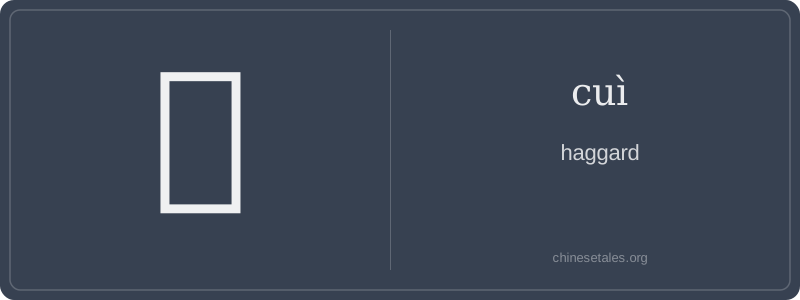
The earliest form of 悴 appears in seal script as a combination of 心 (heart/mind, later simplified to 忄) on the left and 卒 (cù, originally a pictograph of a cloth-covered corpse, later meaning 'soldier' or 'end') on the right. In bronze inscriptions, 卒 depicted a bent figure beneath a shroud — evoking finality, collapse, and irreversible wear. Over centuries, the heart radical emphasized internal state, while 卒’s shape streamlined: its top stroke became the horizontal bar, the middle strokes condensed into two short diagonals, and the bottom evolved into the ‘ten’-like 亠 + 冂 structure — giving us today’s 11-stroke 悴.
This visual fusion — heart + end/collapse — cemented its semantic core: mental or physical depletion so deep it borders on dissolution. By the Han dynasty, it appeared in the Chu Ci (Songs of Chu), where Qu Yuan described his own 'withered and haggard' appearance (形容憔悴) as moral integrity under persecution. The character never meant mere tiredness; it always implied visible, soul-deep erosion — a face that tells a story no words need utter. Even today, seeing 悴 in print triggers a visceral, almost cinematic image of noble exhaustion.
Think of 悴 (cuì) as Chinese literature’s version of a black-and-white film noir close-up: not just 'tired,' but the kind of exhaustion that etches itself into your face — hollow cheeks, shadowed eyes, a quiet unraveling. It’s the look of a poet who hasn’t slept in three days after composing an elegy, or a scholar weeping over fallen dynasties. Unlike generic words like 累 (lèi, 'tired') or 疲惫 (píbèi, 'fatigued'), 悴 is deeply aesthetic and literary — it carries melancholy dignity, never laziness or whininess.
Grammatically, 悴 almost never stands alone. It appears exclusively in disyllabic compounds (e.g., 憔悴, 枯悴), usually as the second character, modifying nouns or functioning as a stative adjective in predicative position: 'His face *is* 憔悴' — not '*He 悴*.' Learners often mistakenly try to use it verbally ('He 悴 yesterday') or as a standalone adjective — a red flag that instantly marks non-native speech. Also, it’s rarely used in casual speech; you’ll find it in poetry, obituaries, historical dramas, or when describing profound emotional or physical depletion.
Culturally, 悴 embodies the Confucian-Buddhist ideal of suffering as refinement: pain that purifies, not degrades. Its near-absence from spoken Mandarin (and the HSK list) reflects how modern Chinese reserves such precise, somber vocabulary for moments of gravitas — making its appearance feel like a hush falling over a room. A common mistake? Confusing it with 萃 (cuì, 'to gather') — same sound, opposite energy: one scatters the spirit, the other concentrates essence.