悱
Character Story & Explanation
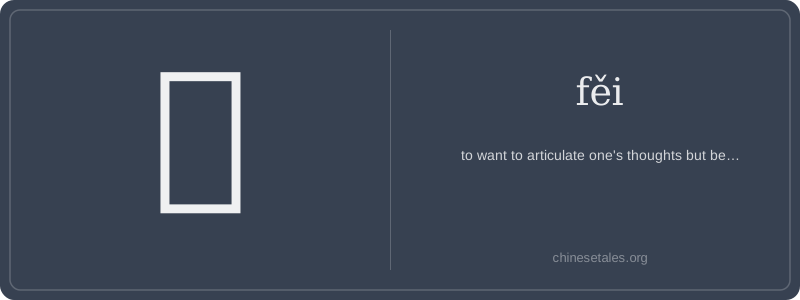
The earliest form of 悱 appears in bronze inscriptions as a combination of 心 (heart/mind) and 匪 (fěi, originally a pictograph of a bent arm holding a tool, later phonetic). In seal script, the left side solidified into 忄 (the 'heart-mind' radical), while the right evolved from 匪 — whose ancient shape suggested 'restraint' or 'holding back', visually reinforcing the idea of thoughts held in check. The 11 strokes crystallized by the Han dynasty: three dots (忄) for emotional pulse, then 匪’s compact, slightly compressed structure — as if the mind itself is gently squeezed, not blocked.
This visual restraint mirrors its semantic journey: from early texts where it described the teacher-learner dynamic (as in the *Analects*), 悱 gradually narrowed to denote the specific affective state preceding articulation — never anger, never panic, always poised, introspective, and literarily refined. By the Tang and Song dynasties, poets used 悱恻 to evoke gentle, lyrical sorrow — not tears, but the tightening behind the eyes. Its shape doesn’t shout; it sighs — and that sigh has echoed in Chinese intellectual life for over two millennia.
Imagine you're at a poetry reading in Suzhou — soft rain tapping the courtyard tiles, ink still wet on your notebook. You feel something profound rising: a mix of longing, insight, and quiet sorrow — but when you open your mouth, only a breath escapes. That suspended moment, that ache of unsaid truth trembling on your tongue? That’s 悱 (fěi). It’s not mere hesitation or shyness; it’s the elegant, almost painful tension between inner clarity and outer articulation — like knowing exactly what to say, yet feeling your voice dissolve before the words form.
Grammatically, 悱 is almost always paired: it appears in classical compounds like 悱恻 (fěi cè) or as part of fixed literary phrases (e.g., ‘悱然’), rarely standing alone. You won’t find it in daily texting or HSK dialogues — it lives in essays, poetry, and reflective prose. Learners sometimes mistakenly use it like 思 (sī, ‘to think’) or 愁 (chóu, ‘to worry’), but 悱 carries zero anxiety about outcomes — only the exquisite friction of thought pressing against speech.
Culturally, this character echoes Confucius’ famous line in the *Analects*: ‘不愤不启,不悱不发’ — ‘I do not enlighten unless the student is eager to understand; I do not instruct unless he is eager to speak.’ Here, 悱 marks the precise mental state where teaching becomes possible: not confusion, not silence, but the fertile verge of expression. Mistake it for frustration or doubt, and you miss its quiet dignity — it’s not failure to speak, but the sacred pause before wisdom finds voice.