悰
Character Story & Explanation
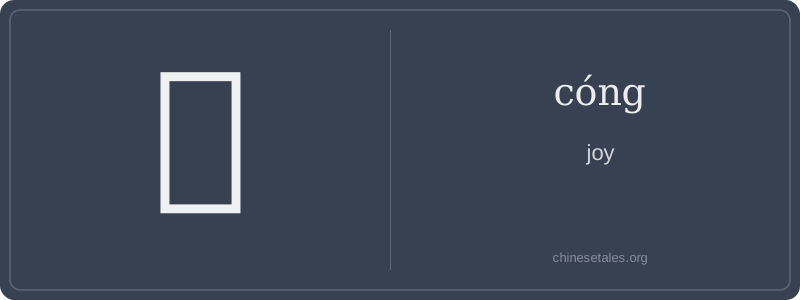
The earliest form of 悰 appears in late Warring States bamboo slips — not as a pictograph, but as a phonosemantic compound. Its left side, the ‘heart’ radical 忄 (a variant of 心), signals emotional domain. Its right side, 从 *cóng*, originally depicted two people walking together in sequence (甲骨文: +人), symbolizing harmony and following — later simplified into the modern 从. Over centuries, the double-person eroded into 人+人, then fused into 从, while the heart radical stabilized on the left. No oracle bone version survives; this character emerged as literacy expanded among scholars who needed precise emotional vocabulary beyond basic 喜.
This visual logic shaped its meaning: joy arising not from external cause, but from inner alignment — 'following the heart's true path'. By the Han dynasty, it appears in the *Shuōwén Jiězì* dictionary defined as *xīn fú ér yuè* (the heart submits and delights), linking moral compliance with bliss. In the *Analects*, Confucius says *jūn zǐ tǎng rán bù yù, xiǎo rén cháng qī* — yet scholars like Zhu Xi later used 悰 to describe the sage’s quiet satisfaction upon realizing *rén* (benevolence). Its shape — heart + 'following' — remains a silent lesson: true joy is not seized, but surrendered to.
Imagine a Tang dynasty poet, ink still wet on silk, pausing before writing the word for 'joy' — not the common xǐ 喜, but 悰: a rare, almost ceremonial term that evokes quiet, radiant elation, like sunlight pooling in a temple courtyard at dawn. This isn’t everyday happiness; it’s joy refined by contemplation, often tied to moral fulfillment or aesthetic harmony. In classical texts, 悰 appears as a verb ('to rejoice') or noun ('a state of serene delight'), never as an adjective — you wouldn’t say *cóng rán* (‘joyful’) like you would *xǐ yuè*. Learners mistakenly use it like 喜 or 樂, but 悰 resists casualness: it’s literary, slightly archaic, and almost always appears in parallel structures or poetic couplets.
Grammatically, 悰 functions primarily as a verb meaning 'to feel deep, composed joy', usually with a subject experiencing moral or spiritual uplift — e.g., *jūn zǐ wén dào ér cóng* (a gentleman hears the Way and rejoices). It rarely takes objects directly; instead, it’s paired with *yú* (‘in/at’) to mark the source: *cóng yú dé* (rejoice in virtue). You’ll almost never see it in spoken Mandarin or modern news — spotting it is like finding a single Song-dynasty teacup in a bustling Shanghai mall.
Culturally, 悰 carries Confucian and Daoist resonance: joy not from gain, but from alignment — with principle (*dào*), with nature (*tiān*), or with one’s true self (*xìng*). Mistaking it for 喜 risks sounding pompous or comically out-of-time (like saying 'verily' instead of 'yes'). Its rarity means even many native speakers recognize it only from classical poetry — making it a delightful 'deep-cut' for learners who want to read Du Fu or Zhuangzi authentically.