悢
Character Story & Explanation
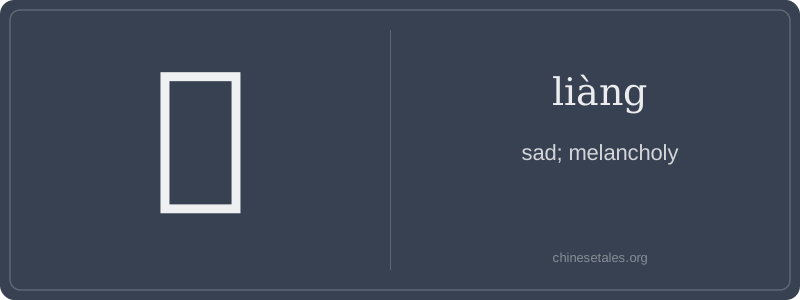
The earliest trace of 悢 appears in seal script (c. 3rd century BCE), where it combines 忄 (the ‘heart’ radical, indicating emotion) with 京 (jīnɡ, ‘capital city’ or ‘elevated structure’) — not as a phonetic loan, but as a visual metaphor: the heart suspended high, exposed and vulnerable, like a watchtower overlooking empty fields. Over centuries, 京 simplified: its top stroke flattened, the middle ‘X’ became two short diagonals, and the bottom ‘口’ shrank into a compact square — giving us today’s 悢. Crucially, this was never a pictograph of crying or weeping — it’s architectural psychology.
This ‘heart-as-tower’ image shaped its meaning: not raw grief, but contemplative, elevated sorrow — the kind that comes with distance and reflection. In the Wen Xuan (Selections of Refined Literature), 悢 describes the stillness after parting, where silence itself feels heavy. Unlike 悲 (which implies outward expression) or 哀 (which connotes ritualized mourning), 悢 is interior architecture — the echo inside an empty hall. Its visual austerity mirrors its semantic restraint: every stroke is necessary; nothing spills over.
Let’s be honest: 悢 (liàng) is a ghost character — haunting classical texts, rarely seen in modern speech, and utterly absent from HSK. Its core meaning is a quiet, deep sadness: not tears or wailing, but the hollow ache of unspoken loss — think of a scholar gazing at fallen plum blossoms in winter, or an old letter left unread on a desk. This isn’t emotional volatility; it’s melancholy as atmosphere, a mood that settles like dust in sunlight.
Grammatically, 悢 behaves like a literary adjective — almost never used alone in speech, and never as a verb or noun. You won’t hear ‘I feel liàng’ — instead, it appears in tightly woven phrases like 悢然 (liànɡ rán, ‘melancholy all at once’) or as a descriptive modifier before nouns (e.g., 悢色, ‘melancholy hue’). Learners often mistakenly treat it like common synonyms such as 悲 (bēi) or 哀 (āi), but 悢 carries no moral weight — it’s aesthetic, not ethical; poetic, not plaintive.
Culturally, 悢 thrives in Tang and Song dynasty poetry, where it evokes refined, introspective sorrow — the kind that lingers in brushstrokes and misty landscapes. A classic pitfall? Confusing it with the homophone 亮 (liànɡ, ‘bright’) — a hilarious semantic whiplash! Also, beware: its radical is 忄 (heart), not 亻 (person), so it’s about inner feeling, not social action. It’s not used in compound verbs or colloquial exclamations — if you see it, you’re reading literature, not texting.