悚
Character Story & Explanation
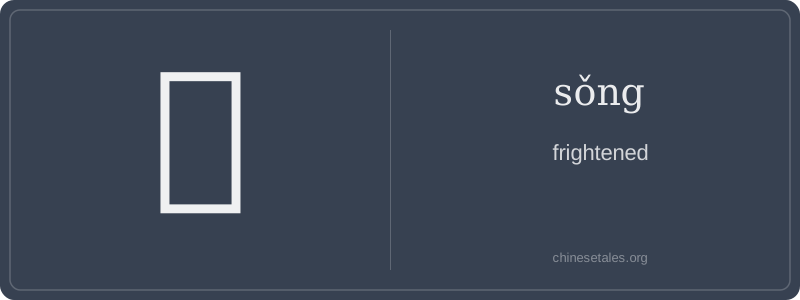
The earliest form of 悚 appears in seal script (c. 3rd century BCE), where it fused two key elements: the heart-mind radical 忄 (a stylized ‘heart’ with three strokes, representing inner feeling) and the phonetic-semantic component 束 (shù), meaning ‘to bind’ or ‘to restrain’. In oracle bone inscriptions, 束 depicted bound twigs — a visual metaphor for constraint. Over centuries, the left side simplified from 心 to 忄, while the right evolved from a complex bundle of sticks into today’s clean, symmetrical 束 (seven strokes: horizontal, vertical, then three horizontals topped by two verticals). The ten-stroke count is precise — no extra flourishes, reflecting the starkness of shock.
This visual logic deepened its meaning: to be 悚 is not merely scared, but *physically constricted by fear* — muscles locked, breath held, mind seized. By the Han dynasty, it appeared in texts like the *Huainanzi*, describing sages who ‘do not tremble (悚) at thunder’, implying moral mastery over involuntary fright. Later, in Tang poetry and Ming-Qing ghost stories, 悚 became the go-to word for uncanny dread — always paired with bodily sensation (e.g., 悚然 — ‘startled upright’). Its endurance lies in that perfect fusion: a heart radical + binding imagery = fear you can feel in your ribs.
At its core, 悚 isn’t just ‘frightened’ — it’s the visceral, hair-raising jolt of sudden dread: the gasp before the scream, the spine-tingling chill when you hear footsteps behind you in an empty hallway. Unlike generic fear words like 害怕 (hài pà) or 恐惧 (kǒng jù), 悚 carries literary weight and physiological immediacy — it’s how classical poets described ghosts stirring at midnight, and how modern suspense novelists make your pulse skip. It almost never stands alone; you’ll nearly always see it in compounds (e.g., 毛骨悚然) or as a verb complement after verbs like 感到 (gǎn dào) or 吓得 (xià de).
Grammatically, 悚 is rarely used predicatively without support — saying *‘他悚’ is unnatural. Instead, it appears in tightly bound idioms or as the second character in reduplicated or four-character structures. Learners often overuse it trying to sound ‘literary’, but native speakers reserve it for heightened, atmospheric moments — think horror fiction, psychological thrillers, or solemn historical accounts. It’s also tone-sensitive: sǒng (third tone) rhymes with ‘song’, reinforcing its echo-like, resonant quality — not a shout, but a shiver that vibrates inward.
Culturally, 悚 reflects the Chinese aesthetic of restraint in emotion: true terror isn’t loud; it’s silent, internal, and physically embodied (hence its radical 忄—‘heart/mind’). A common mistake is confusing it with 竦 (sǒng), an archaic variant now obsolete in mainland usage — but 悚 won out precisely because its right-hand component (束) suggests ‘constriction’, mirroring how fear tightens the chest and freezes breath. That subtle somatic logic is pure classical Chinese psychology in one character.