悖
Character Story & Explanation
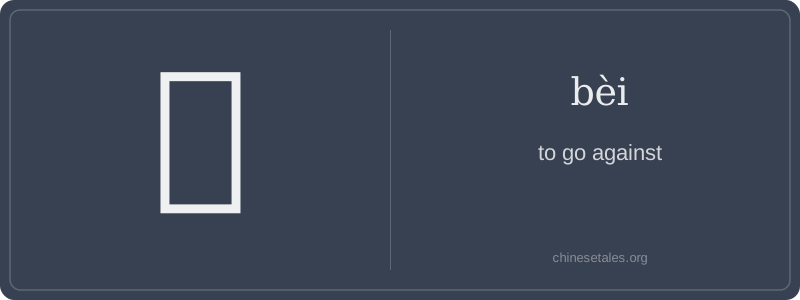
The earliest form of 悖 appears in Warring States bamboo slips, combining 忄 (heart/mind radical) with 倍 (bèi, ‘to double, to betray’). Though not pictographic, its structure tells a story: the left side 忄 signals inner mental or moral stance; the right side 倍 originally depicted a person (亻) beside a vessel (咅), evolving to mean ‘to deviate from the standard’ — later acquiring the sense of ‘betrayal’ or ‘violation’. Over centuries, the top stroke of 倍 simplified, and the character stabilized into its current 10-stroke form: three dots on the left (heart), then 亻+咅 fused into a compact right component.
By the Han dynasty, 悖 had crystallized into its core meaning: ‘going against principle, nature, or reason’. The Book of Rites uses it to condemn actions that violate ritual propriety (礼), while Wang Chong’s Lunheng employs 悖 to dismiss superstitious claims as contradicting natural law. Crucially, its heart radical anchors the idea that contradiction isn’t just external — it’s a failure of moral cognition. Even today, 悖 feels less like ‘logically flawed’ and more like ‘morally dissonant’ — a subtle but profound distinction baked into its very strokes.
Think of 悖 (bèi) as the Chinese word for 'a hard no' — not just disagreement, but a fundamental violation of logic, principle, or natural order. It’s not casual like ‘I don’t agree’; it’s the weight of ‘This contradicts the laws of heaven and earth!’ You’ll rarely hear it in daily chatter — it’s literary, formal, and often appears in classical phrases, legal texts, or philosophical critique. Its emotional charge is sharp and slightly stern: imagine a Confucian scholar raising an eyebrow at a ruler’s unjust decree.
Grammatically, 悖 almost never stands alone. It’s nearly always part of compounds (like 悖理 or 悖逆) or used predicatively with 是 or 为: 这种说法是悖的 (‘This claim is contradictory’). Learners sometimes mistakenly try to use it like 反对 (to oppose) — but 悖 isn’t about action or opinion; it’s about inherent inconsistency. You don’t ‘bèi someone’ — you ‘bèi reason’, ‘bèi facts’, or ‘bèi morality’.
Culturally, 悖 carries moral gravity. In classical texts, calling something 悖 was a serious rhetorical move — implying disorder in the cosmic or ethical fabric. Modern usage retains that seriousness: calling a policy 悖理 sounds like a constitutional challenge, not a petty complaint. A common mistake? Overusing it like ‘wrong’ or ‘false’. Remember: 悖 is not semantic error — it’s structural rebellion against logic itself.