悒
Character Story & Explanation
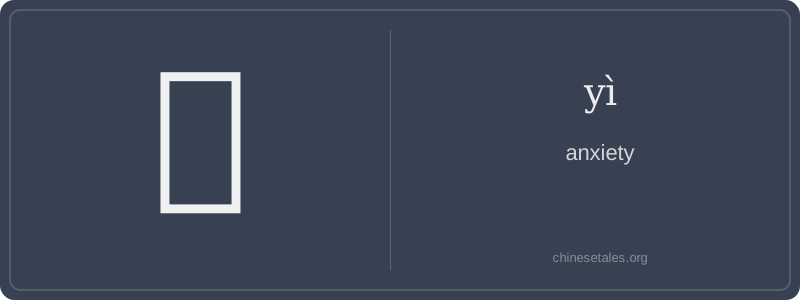
The earliest form of 悒 appeared in bronze inscriptions around 800 BCE as a combination of 心 (heart/mind) and 易 (a stylized pictograph of a container with liquid spilling — symbolizing instability or change). In oracle bone script, 心 was drawn as a pulsing organ, and 易 resembled a vessel tipping — together, they visualized ‘the heart unsettled by shifting circumstances’. Over centuries, 心 evolved into the left-side radical 忄 (‘heart-mind’), while 易 simplified: its top became 日 (sun), middle became 勹 (a curved enclosure), and bottom became 勿 (a variant stroke cluster), yielding today’s 10-stroke structure — still whispering ‘heart + instability’.
By the Han dynasty, 悒 solidified as a literary term for ‘melancholy anxiety’, appearing in Ban Gu’s Hanshu to describe officials overwhelmed by moral uncertainty. Its visual duality — stable-looking strokes masking inner turbulence — mirrors its meaning: outward composure, inward disquiet. Unlike modern clinical terms, 悒 never meant ‘illness’; it described a cultivated, almost aesthetic sensitivity to life’s fragility — the kind of feeling you’d find in Tang dynasty moonlit poems, not therapy intake forms.
At its heart, 悒 is the quiet, heavy kind of anxiety — not panic or fear, but that low hum of unease, like fog settling in your chest. It’s introspective, almost literary: you wouldn’t say 悒 in casual chat; it appears in poetry, classical essays, or solemn medical reports describing a patient’s ‘depressed and anxious state’. The character carries a weight of restrained emotion — think melancholy with intellectual dignity, not meltdown.
Grammatically, 悒 is almost always used as a descriptive adjective or in compound nouns (like 憂悒), rarely alone. You’ll never see it as a verb (*‘to 悒’ isn’t a thing) or in imperative constructions. Learners often misapply it like English ‘anxious’, trying to say ‘I’m 悒 about the exam’ — but native speakers would use 焦虑 or 紧张 instead. 悒 belongs in phrases like ‘面色悽然,神情悽悒’ — describing someone’s demeanor, not your own fleeting worry.
Culturally, 悒 evokes the Confucian ideal of emotional restraint: it’s anxiety *held in*, not expressed. That’s why it’s absent from HSK — it’s too poetic, too archaic for daily fluency. Mistake to avoid: don’t confuse its tone (yì, fourth tone) with yī (first tone) — saying ‘yī’ makes it sound like ‘easy’ or ‘one’, instantly breaking the mood. And yes — it rhymes with ‘eat’, which helps: imagine eating your worries until they’re just a dull, lingering 悒.