悐
Character Story & Explanation
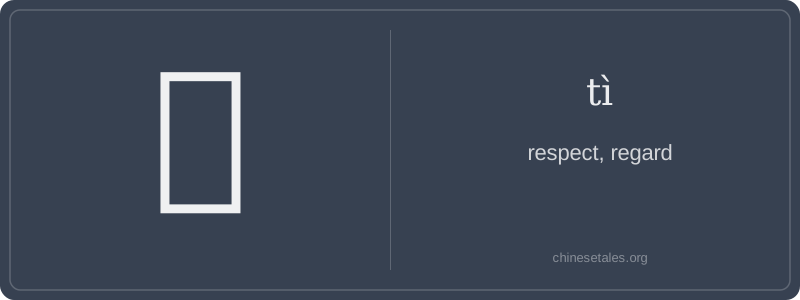
The earliest form of 悐 appears in bronze inscriptions as a combination of 心 (xīn, 'heart') on the left and 弟 (dì, 'younger brother') on the right — not the modern 'brother' glyph, but an ancient pictograph showing a kneeling figure beside a ritual vessel, symbolizing humility in kinship hierarchy. Over time, the 'kneeling' element simplified, the vessel morphed into the top part of 弟, and the heart radical remained steadfast — anchoring the meaning in emotional sincerity rather than mere ritual obedience.
This visual logic carried deep into classical texts: in the Book of Rites (Lǐjì), 悐 appears in passages about 'regarding one’s elder brother as a teacher' — respect rooted in relational awareness, not blind duty. By the Han dynasty, scribes began merging 悐 with 悌, since both expressed hierarchical affection within the family. The character didn’t vanish — it dissolved elegantly into 悌, carrying its heart-centered nuance forward. So when you see 悐 today, you’re glimpsing a vanished branch of the same semantic tree — one that prioritized inner regard over outward form.
Let’s be honest: 悐 (tì) is a quiet, elegant ghost of classical Chinese — it carries the warm weight of 'respect' and 'regard', but not in the loud, bowing-down sense you might expect. It’s more like the soft, attentive pause before speaking to an elder, or the gentle nod that says, 'I see you, and I value your presence.' Think of it as respect with quiet intention — not performance, but posture of the heart.
Grammatically, 悐 is almost never used alone today; it lives exclusively in compound words (like 敬悐 or 悐慕), and crucially, it’s a *literary* character — you won’t hear it in daily speech or find it in HSK textbooks. Learners sometimes try to substitute it for 敬 (jìng) or 尊 (zūn), but that’s like using 'thou' instead of 'you' in modern English: technically correct, historically rich, but wildly out of place. Its grammar is frozen in elegance — always paired, always formal, always written, never spoken casually.
Culturally, 悐 reflects a Confucian subtlety: respect isn’t just action (bowing, titles); it’s inner orientation — how you hold space for another person’s dignity. A common mistake? Assuming it’s interchangeable with 敬. But while 敬 can mean 'reverence' or even 'to offer sacrifices', 悐 leans toward empathetic regard — close to 'esteem' or 'cherish'. And yes, its stroke count is zero *in modern dictionaries* because it’s been officially deprecated: it’s a historical variant of 悌 (tì), meaning 'filial respect toward elder brothers', and was absorbed into that character’s usage centuries ago.