悍
Character Story & Explanation
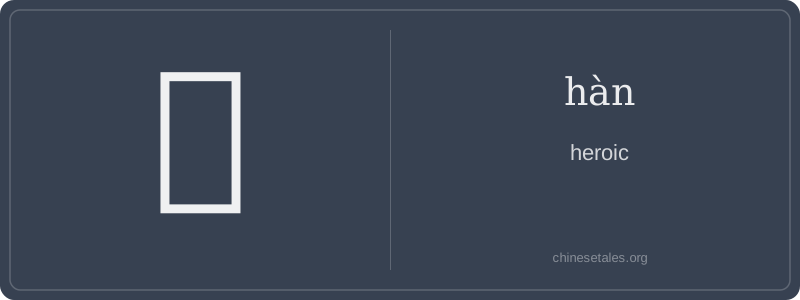
The earliest form of 悍 appears in Warring States bamboo texts, combining 忄 (xīn — the ‘heart/mind’ radical, indicating emotional intensity) with 干 (gān — originally a pictograph of a weapon like a spear or halberd, later simplified to its current shape). In bronze inscriptions, 干 sometimes showed two crossed spears — symbolizing readiness for combat. Over centuries, the left side solidified as 忄 (not 心, because 忄 is the standard left-radical variant), while the right evolved from a more complex weapon glyph into the streamlined 干 we know today — 10 strokes total: three dots for 忄, then seven for 干 (including the horizontal stroke, vertical, and two diagonal slashes).
This visual marriage — heart + weapon — tells the whole story: inner resolve fused with outward readiness to act. By the Han dynasty, 悍 appeared in the Shuōwén Jiězì dictionary defined as ‘strong-willed and unyielding’ (剛強不屈). It gained literary weight in Tang poetry describing frontier generals and Ming novels like Water Margin, where heroes like Li Kui are called 悍將 (fierce generals) — not for cruelty, but for unstoppable moral ferocity. The character never lost its visceral charge: it’s not calm heroism, but heroism that breaks silence, shatters hesitation, and leaves a dent in the world.
Imagine a lone warrior standing atop a windswept cliff, armor dented, banner torn — not fleeing, but roaring defiance at an oncoming storm of arrows. That’s 悍: not just 'brave' or 'strong', but fiercely, unyieldingly heroic — raw courage that refuses to bend, even when logic says 'retreat'. It carries heat, grit, and a touch of recklessness. You’ll rarely see it describing quiet virtue; it’s for the general who charges alone, the activist who blocks bulldozers barehanded, or the mother who slams her body between her child and danger.
Grammatically, 悍 is almost always an adjective — but never used alone. It only appears in compounds (like 悍然, 悍勇) or as a modifier before nouns (悍将, 悍匪). You’d never say *‘Tā hàn’* ('He is heroic') — that sounds unnatural and incomplete. Instead, it’s embedded: ‘hàn yǒng de jiāng lǐng’ (a heroic commander), where 悍 intensifies the noun’s inherent boldness. Learners often mistakenly treat it like 勇 (yǒng) and try to use it predicatively — a subtle but glaring error that makes native speakers pause.
Culturally, 悍 walks a razor’s edge: admired in martial contexts and historical epics, yet subtly cautioned against in Confucian-influenced speech — where restraint (克己) is prized over forceful display. Its modern usage leans slightly negative when applied to people (e.g., 悍妇 ‘fierce wife’, now outdated but still evocative), revealing how ‘heroic’ can shade into ‘overbearing’ depending on gendered expectations. So while English glosses it as ‘heroic’, think: ‘heroic with teeth’ — uncompromising, visceral, and never polite.