悌
Character Story & Explanation
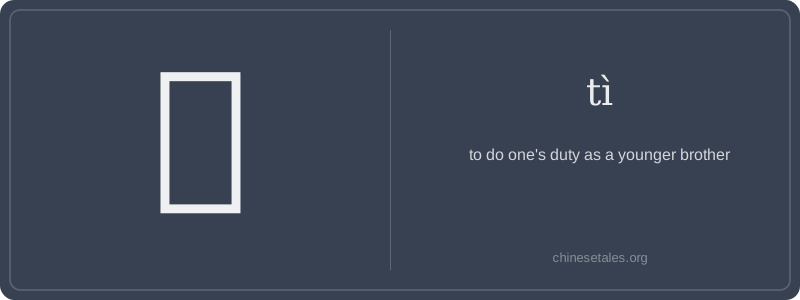
The earliest form of 悌 appears in Warring States bamboo texts as a variant of 弟 (dì, ‘younger brother’), with the 忄 (heart-mind) radical added later to emphasize its moral dimension. Visually, it’s a masterclass in semantic layering: the right side 弟 originally depicted a man kneeling beside a ceremonial vessel — symbolizing submission and ritual humility. Over centuries, the kneeling figure simplified into the modern 弟 component (7 strokes), while the left 忄 radical (3 strokes) was grafted on around the Han dynasty to signal this wasn’t just kinship — it was *felt obligation*, rooted in the heart.
This visual fusion crystallized its meaning in the Analects and Mencius, where 悌 became inseparable from social harmony: ‘A person who practices filial piety and fraternal duty (孝悌) will rarely defy authority’ (Analects 1.2). Interestingly, 弟 itself meant ‘younger brother’ long before 悌 existed — but adding 忄 transformed it from a noun into an ethical compass. The character doesn’t depict action (like ‘bowing’); it depicts *intentional alignment of heart and role* — making it one of the earliest Chinese characters to encode internal moral posture as visual grammar.
At its heart, 悌 (tì) isn’t just ‘being polite to your older brother’ — it’s the quiet, disciplined heartbeat of Confucian kinship: the conscious, respectful yielding of a younger sibling. Think of it as emotional choreography — bowing slightly when passing, speaking softly in elders’ presence, deferring in decisions — all encoded in a single character. It carries warmth but no informality; duty without resentment, reverence without distance.
Grammatically, 悌 rarely stands alone in modern speech — you won’t hear someone say ‘I tì my brother.’ Instead, it lives in classical compounds and formal moral discourse. You’ll find it in set phrases like 孝悌 (xiào tì), where it pairs with ‘filial piety’ to form the foundational virtue duo:孝 for parents, 悌 for siblings and peers. Learners often mistakenly treat it as a verb meaning ‘to respect,’ but it’s almost always nominal or adjectival — describing a *quality* (e.g., 悌道 ‘the way of fraternal duty’) or appearing in fixed ethical terms.
Culturally, 悌 reflects how deeply Chinese ethics map hierarchy onto affection. Unlike Western ‘brotherly love,’ which emphasizes equality or emotion, 悌 is about *orderly care*: younger siblings don’t just love — they *align*. A common error? Using it in casual conversation (e.g., ‘I’m very tì to my brother’) — that sounds like quoting a Ming dynasty textbook at brunch. It belongs in essays on virtue, not WeChat messages.