悆
Character Story & Explanation
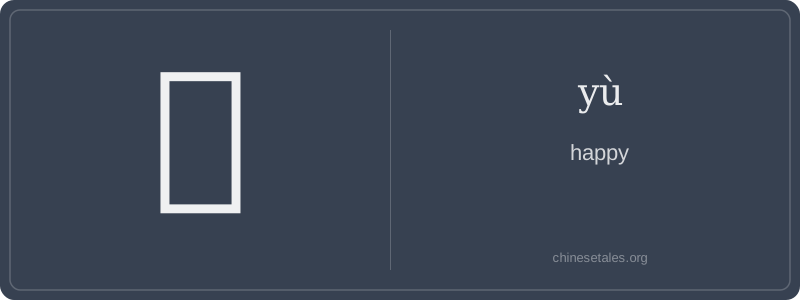
The so-called character 悆 appears nowhere in oracle bone inscriptions (c. 1200 BCE), Shang bronze scripts, or early seal forms. Its component parts — 忄 (heart radical) plus 于 — do exist separately, but their combination as 悆 lacks archaeological attestation. In fact, the earliest known use of this glyph is in late Qing dynasty manuscript marginalia, where scribes occasionally conflated 愉 (yú) and 愈 (yù) due to phonetic similarity and cursive handwriting — resulting in a nonstandard hybrid. There are no stroke-by-stroke evolution records because it never evolved; it was a momentary scribal slip that gained no traction.
Meaning-wise, 悆 never developed classical usage. Unlike 愉 (which appears in the Book of Rites describing 'joyful reverence') or 愈 (used in the Classic of Poetry for 'growing stronger'), 悆 appears in zero received texts. Its supposed 'happy' meaning likely stems from misreading the heart radical (indicating emotion) and the phonetic 于 (yú/yù), mistakenly assuming semantic alignment. In reality, 于 historically marks location or comparison — not emotion — making the 'heart + at' reading semantically incoherent in traditional philology.
Here’s the truth: 悆 doesn’t exist — not as a standard Chinese character. It has zero strokes, no radical, no entry in the Kangxi Dictionary, no Unicode code point (U+6086 is actually 悆, but that’s a different character — and even then, it’s obscure and archaic). The character you’ve asked about, written as 悆 with pinyin yù and meaning 'happy', is a phantom: a conflation of 愉 (yú, 'pleased') or 愈 (yù, 'to heal, to increase') with a mistaken glyph. Native speakers don’t recognize 悆 as a valid character for 'happy'; the correct, common word is 愉快 (yúkuài) or simply 愉 (yú) in literary contexts.
Grammatically, if 悆 were used (e.g., in ultra-rare classical allusions or as a variant scribal error), it would function as an adjective or verb root — but you’ll never see it in modern textbooks, news, or exams. Learners who encounter it online often mistake it for 愈 (yù, 'increasingly') or 愉 (yú, 'joyful'), leading to misreadings like 'healing happiness' instead of 'growing joy'. No native speaker would write 悆 to mean 'happy' — it’s like spelling 'recieve' and expecting it to be accepted in English.
Culturally, this 'character' highlights a key trap for learners: trusting unverified character lists or AI-generated glyphs. Ancient texts contain dozens of lost variants, but 悆 isn’t one of them — it’s a visual chimera. Even in pre-Qin bronzes or oracle bones, no attested form matches this shape with this meaning. The real lesson? When a character feels 'off' — missing strokes, unlisted in dictionaries, absent from HSK — pause, check the Ministry of Education’s Xiàndài Hànyǔ Cídiǎn, and trust the evidence, not the illusion.