悃
Character Story & Explanation
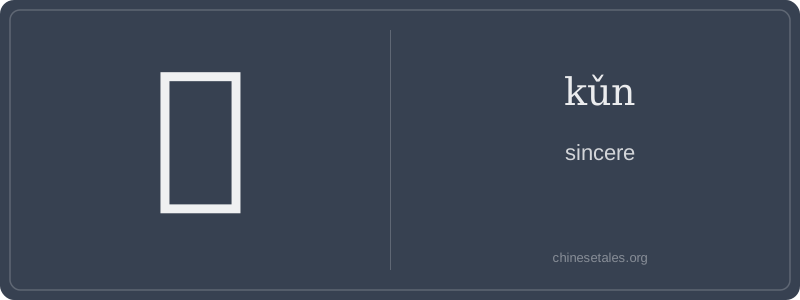
The earliest form of 悃 appears in Warring States bamboo slips as a variant of 恳, sharing its core structure: 忄 (heart radical) on the left, and 困 (a person trapped inside a frame, later simplified to represent constraint or earnestness) on the right. Originally, 困 wasn’t about hardship — it depicted a person kneeling inside a boundary, symbolizing focused, undivided attention. When paired with 忄, the whole character visualized ‘heart fully contained within intention’ — no distraction, no pretense, just pure inward focus directed outward.
This image crystallized into the modern 10-stroke 悃 by the Han dynasty. Though often conflated with 恳 (kěn, also meaning ‘sincere’), 悃 retained a more austere, classical flavor — appearing in Tang poetry and Ming-era moral essays to describe the sincerity of sages and loyal ministers. Its visual restraint (no extra flourishes, no phonetic hints beyond 困) mirrors its semantic precision: sincerity stripped bare, without embellishment or plea.
Imagine you’re meeting a Chinese elder for the first time — they bow slightly, make quiet eye contact, and speak with unhurried warmth. Their words aren’t flashy or loud, but you feel *kǔn*: a deep, unadorned sincerity that settles in your chest like warm tea. That’s 悃 — not just ‘sincere’ as in ‘I mean it’, but sincerity as moral gravity: heartfelt, unfeigned, and quietly resolute. It’s the kind of sincerity Confucius praised — rooted in inner integrity, not performative kindness.
Grammatically, 悃 is almost always found in compound nouns or adjectives (like 悃诚), rarely standing alone. You’ll never say *‘wǒ hěn kǔn’* — that sounds unnatural, like saying ‘I am very sincerity’ in English. Instead, it modifies nouns (*kǔn chéng de tàidù* — a sincere attitude) or appears in formal written contexts: letters, speeches, official statements. Learners often mistakenly use it like a standalone adjective — a red flag to native speakers who expect it only in set phrases.
Culturally, 悃 carries classical weight. In pre-modern texts, it described the sincerity required before ritual or oath-taking — a prerequisite for trustworthiness. Today, it’s still preferred in solemn, respectful registers: honoring teachers, pledging loyalty, or expressing remorse. Misusing it casually (e.g., texting ‘kǔn!’ to a friend) feels oddly archaic — like signing off an email with ‘Verily, yours’.