悁
Character Story & Explanation
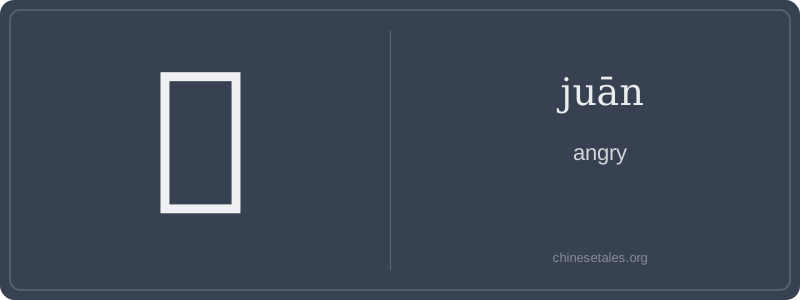
The earliest form of 悁 appears in bronze inscriptions as a combination of 心 (xīn, 'heart') on the left and 眷 (juàn, 'to look back fondly') on the right — but crucially, the 'eye' component (目) in 眷 was stylized to suggest narrowed, intense gaze, not affection. Over centuries, the right side simplified: the 'eye' shrunk, the 'scroll' () evolved into 倦’s top, and the whole character compacted into today’s 悁 — still clearly 心 + a tense, downward-leaning right-hand element suggesting constrained focus and inner pressure.
This visual evolution mirrors its semantic journey: from 'looking back with emotional weight' (early bronze usage) to 'heart burdened by unresolved grievance' (Warring States texts). In the Shuōwén Jiězì (121 CE), Xu Shen defines it as 'anger arising from injustice one cannot voice' — a definition echoed in Tang poetry where 悁 describes poets’ silent outrage at court corruption. Its shape — heart + compressed gaze — perfectly encodes restrained fury: eyes downcast, heart tight, voice held.
Imagine a Ming dynasty scholar, ink still wet on his brush, slamming it down after reading an unjust edict — not roaring, but with a quiet, seething intensity. That’s 悁 (juān): not explosive anger like 怒 (nù), nor righteous indignation like 憤 (fèn), but the tightly coiled, inward-burning resentment that makes your temples pulse and your breath shallow. It’s the kind of anger you swallow — bitter, dignified, and deeply personal.
Grammatically, 悁 is almost exclusively literary or classical. You won’t hear it in casual speech or HSK dialogues; instead, it appears in compound words (like 悁悁) or as a poetic adjective describing a state of simmering displeasure — often modifying nouns (e.g., 悁悁之色, 'a countenance flushed with suppressed anger'). It rarely stands alone as a verb; you wouldn’t say 'I 悁' — you’d say '我心中悁悁' ('my heart feels 悁'). Learners mistakenly treat it like modern verbs — but it’s more like an emotional hue than an action.
Culturally, 悁 carries Confucian restraint: anger acknowledged but never uncontrolled. Mistaking it for common synonyms (like 气 or 怒) misses its nuance — this is anger with decorum, even sorrow beneath the heat. Its rarity today makes it a linguistic fossil: beautiful, precise, and quietly fierce — a reminder that Chinese has dozens of words for anger, each with its own moral temperature.