恬
Character Story & Explanation
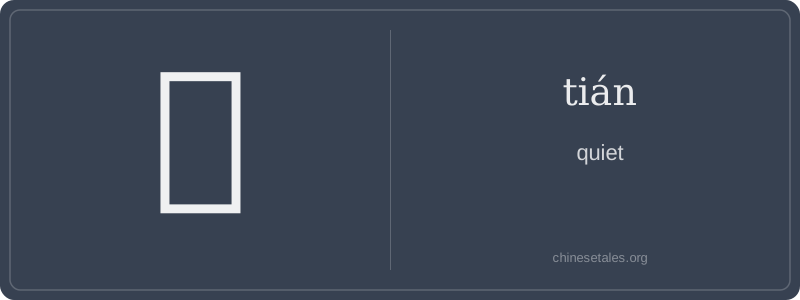
The earliest form of 恬 appears in Warring States bamboo texts—not oracle bones—as a compound character merging 忄 (heart-mind radical) with 甘 (gān, ‘sweet’ or ‘pleasing’), originally written with a simplified mouth shape over a ‘grain’ component. In bronze script, 甘 looked like a mouth cradling something nourishing, evoking sensory satisfaction. Over centuries, the top of 甘 simplified into the two horizontal strokes and dot we see today, while the left-side 忄 evolved from the full 心 (xīn, ‘heart’) radical—keeping the emotional core intact. By the Han dynasty, the modern 9-stroke form stabilized: three strokes for 忄, then six for the 甘-derived right side.
This visual logic is profound: ‘sweet heart’ → inner contentment → untroubled calm. The character wasn’t born from silence, but from pleasure so deep it silences desire. In the Zhuangzi, 恬 appears in passages praising the sage who ‘dwells in 恬漠’ (tranquil vastness)—a state beyond joy or sorrow. Its evolution mirrors Chinese philosophy: true quiet isn’t emptiness, but the fullness of harmony within. Even today, when writers choose 恬 over other ‘quiet’ words, they’re invoking that ancient, embodied stillness—not absence, but arrival.
At its heart, 恬 (tián) isn’t just ‘quiet’ like a library hush—it’s the deep, unshakable calm of a mountain lake at dawn: serene, self-contained, and emotionally still. It describes an inner tranquility, not mere silence—think of someone who remains unperturbed amid chaos, or a face radiating peaceful composure. Unlike common synonyms like 静 (jìng), which is neutral and often physical (‘silent room’), 恬 carries a gentle, almost virtuous warmth—it’s the quiet of contentment, not absence.
Grammatically, 恬 is almost always used as a stative adjective—never as a verb or noun—and appears most frequently in literary or formal contexts: in compound words (e.g., 恬淡, 恬静), fixed phrases, or classical-style descriptions. You won’t hear it in casual speech like ‘I’m quiet today’—that’s 静 or 安静. Instead, you’ll see it in writing: ‘她神情恬然’ (her expression was serenely composed), where 恬 modifies a noun via the particle 然, or in four-character idioms like 恬不为意 (to remain utterly unconcerned). Learners often mistakenly try to use it predicatively without support—‘他很恬’ sounds jarringly unnatural; it needs structure or compounding.
Culturally, 恬 reflects Daoist and Confucian ideals of inner equilibrium—calm not as passivity, but as cultivated moral poise. Mistake alert: Don’t confuse it with 添 (tiān, ‘to add’) or 舔 (tiǎn, ‘to lick’)—same sound, wildly different meanings! And while 静 can describe noise levels, 恬 never does: you’d never say ‘这地方很恬’ about a quiet café. Its power lies in human stillness—not environmental silence.