恫
Character Story & Explanation
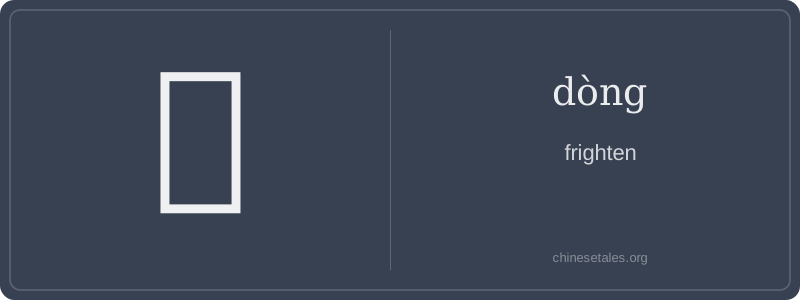
The earliest form of 恫 appears in Warring States bamboo slips, not oracle bones — and it’s a masterclass in semantic fusion. Its left side 忄 (xīn) is the ‘heart-mind’ radical, unmistakably signaling emotion. The right side, 東 (dōng — ‘east’), is a phonetic loan: it contributes sound (dōng → dòng, with tone shift) but no meaning — yet visually, its stacked horizontal strokes (一丨一丨) subtly echo trembling limbs. Over centuries, the character streamlined: the original bronze script’s elaborate ‘heart’ variant simplified to 忄, while 東 lost decorative flourishes, settling into today’s clean nine-stroke structure.
This phonosemantic pairing — heart + east-as-sound — became entrenched in early dictionaries like the Shuōwén Jiězì (121 CE), which defined 恫 as ‘fear that shakes the heart’. Classical poets like Du Fu used it to depict wartime trauma: ‘烽火连三月,家书抵万金。白头搔更短,浑欲不胜簪。’ — though 恫 doesn’t appear here, its semantic kinship with 狂 (kuáng, madness) and 惶 (huáng, anxiety) reveals how deeply it belongs to China’s lexicon of embodied distress. Visually, the nine strokes feel deliberately urgent — the sharp downward stroke of 忄 followed by 東’s compact, cage-like framing suggests confinement under fear.
At its core, 恫 (dòng) isn’t just ‘to frighten’ — it’s the visceral, gut-level jolt of alarm: the sudden cold sweat, the skipped heartbeat, the instinctive recoil. Think less ‘scare’ and more ‘startle into paralysis’. It carries a literary, almost archaic weight; you won’t hear it in casual chats like ‘That movie scared me!’ — for that, you’d use 害怕 (hàipà) or 吓 (xià). Instead, 恫 appears in formal writing, classical allusions, or psychological descriptions where the fear is profound and involuntary.
Grammatically, 恫 functions almost exclusively as a verb — but rarely alone. It’s nearly always embedded in compounds (like 恫吓 or 恫疑), or used in literary passive constructions: e.g., ‘被其言所恫’ (bèi qí yán suǒ dòng — ‘frightened by his words’). Learners often mistakenly treat it like a modern monosyllabic verb and try to say *‘tā dòng wǒ’* — but that sounds jarringly unnatural, like saying ‘He frighten me’ in English without ‘-ed’. Native speakers expect compound forms or classical syntax.
Culturally, 恫 evokes moral unease as much as physical fear — Confucian texts use it to describe the dread of violating ritual propriety (礼 lǐ), not just jumping at thunder. A common mistake is overgeneralizing it to mean ‘intimidate’ in business contexts; that’s better covered by 威胁 (wēixié). Also, don’t confuse its tone: it’s fourth tone (dòng), not second (dóng) — mispronouncing it risks sounding like the unrelated word ‘dong’ (cave) or even a homophone for ‘move’ (动).