恪
Character Story & Explanation
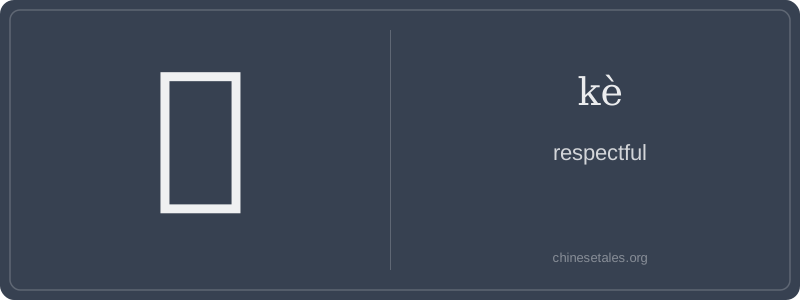
The earliest form of 恪 appears in bronze inscriptions (c. 1000 BCE) as a compound: the heart radical 忄 (showing internal state) + 各 (gè), which originally depicted a foot descending toward a mouth — symbolizing ‘arrival at a sacred place’ or ‘coming to pay homage’. Over centuries, 各 evolved: its ‘foot’ (夂) simplified, its ‘mouth’ (口) became more angular, and the heart radical stabilized on the left. By the Han dynasty, the modern nine-stroke shape emerged — a clean, upright structure mirroring its meaning: inner devotion made visible in posture and conduct.
This visual logic shaped its semantic journey: from ‘arriving with reverence’ → ‘holding fast to what is due’ → ‘conscientious adherence’. In the *Book of Rites* (Lǐjì), 恪 appears in phrases like 恪慎其身 (‘scrupulously cautious in one’s person’), linking bodily discipline to moral clarity. The character’s very balance — three strokes left (忄), six right (各) — reflects harmony between inner intention and outward action. Even today, calligraphers emphasize its vertical stroke in 各 as the ‘spine’ of respect: unbroken, unbending, essential.
Imagine a quiet, incense-scented ancestral hall in Suzhou — a young scholar bows deeply before the family altar, spine straight, eyes lowered, hands folded with precise symmetry. His posture isn’t stiff; it’s *kè*: reverent, unwavering, infused with conscious discipline. That’s 恪 — not just ‘respectful’ as a vague feeling, but respect as *active fidelity*: honoring duty, tradition, or principle with solemn consistency. It’s the kind of respect you *uphold*, not just feel.
Grammatically, 恪 is almost always an adjective preceding a noun (e.g., 恪守原则 — ‘strictly uphold principles’) or paired with verbs like 守 (shǒu, ‘to guard’) or 尽 (jìn, ‘to fulfill’). You won’t say ‘I am kè’ alone — it needs context: 恪尽职守 (‘dutifully fulfill one’s duties’), 恪守本分 (‘scrupulously adhere to one’s proper role’). Learners often mistakenly use it like a standalone descriptor (e.g., *tā hěn kè*), but native speakers avoid that — it sounds unnatural, even archaic, unless in highly literary or ritual speech.
Culturally, 恪 carries Confucian gravity — it’s the quiet backbone of integrity, not performative politeness. It appears frequently in formal writing, epitaphs, and official commendations, especially for civil servants or educators. A common error? Confusing it with 客 (kè, ‘guest’) or 格 (gé, ‘standard’) — both sound similar but lack its moral weight. Also, note: 恪 is rarely used in casual speech; hearing it in daily conversation is like spotting a classical ink painting in a subway station — rare, deliberate, and deeply meaningful.