恛
Character Story & Explanation
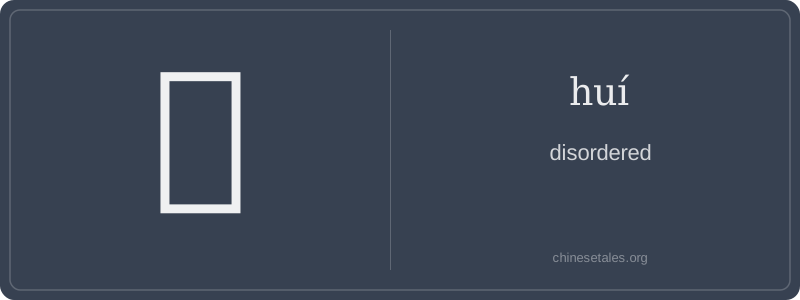
The earliest form of 恛 appears in late Warring States bamboo slips as a variant of 回 — which itself was a pictograph of swirling water or a coiled path (like ⭕). But 恛 added the 'heart-mind' radical 忄 (shùn pāng) to the left, transforming it from 'circular motion' into 'circular disturbance within the heart'. Visually, it evolved from a bronze-script glyph with three concentric curves (depicting chaotic eddies) + 心, then simplified to the modern structure: 忄 + 回 — literally 'heart-in-circles', suggesting thoughts spinning without resolution.
This semantic shift crystallized in Han dynasty medical texts like the Huangdi Neijing, where 恛 described 'qi reversing in the channels', causing dizziness and mental fog. By the Tang, poets like Li He used 恛惑 to depict hallucinatory states induced by grief or illness — not metaphor, but clinical observation. The character’s visual logic remains striking: the 忄 radical grounds the disorder in emotion, while 回’s looping shape mirrors the recursive, inescapable nature of pathological thought — no exit, only whirl.
Imagine you're flipping through an ancient medical manuscript from the Tang dynasty, and your finger stumbles on a cryptic diagnosis: '心神恛亂' — not 'confused', not 'anxious', but something more visceral: a mind so deeply disordered it’s like ink spilled in swirling water, losing all shape. That’s 恛 (huí): not everyday chaos, but a profound, almost physiological disarray — of thoughts, qi flow, or emotional balance. It carries a classical weight, evoking imbalance in Daoist cosmology or TCM pathology, not modern slang.
Grammatically, 恛 is almost never used alone. It appears only in fixed, literary compounds — always paired, never as a verb or standalone adjective. You’ll never say '他很恛'; instead, it anchors phrases like 恛惑 (huí huò) or 恛亂 (huí luàn), where it intensifies the sense of destabilization. Learners often misread it as 回 (also huí, 'to return') — a fatal slip that turns 'mental disarray' into 'mental returning'!
Culturally, 恛 is a ghost character: rare in speech, nearly extinct in modern writing, yet preserved in classical texts, poetry, and Traditional Chinese Medicine diagnostics. Its rarity makes it a telltale sign of advanced reading — spotting 恛 is like finding a fossil in a textbook. Mistake it for 回 or 灰 (huī, 'ash'), and you’ll misdiagnose ancient ailments or misinterpret Song dynasty lyrics. It’s not about vocabulary size — it’s about recognizing textual DNA.