恚
Character Story & Explanation
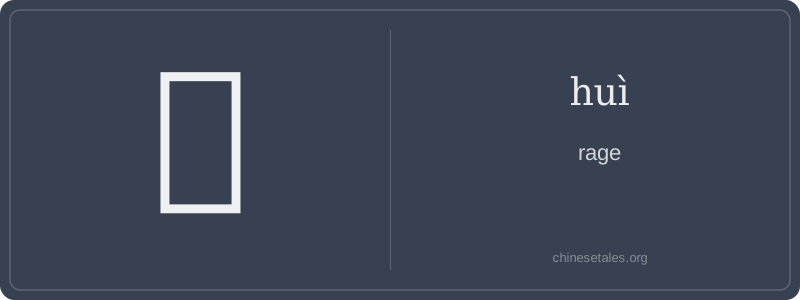
The earliest form of 恚 appears in Warring States bamboo texts, not oracle bones — and it’s a masterclass in visual psychology. Its left side 心 (xīn, 'heart') anchors the emotion, while the right side was originally 帰 (guī, an archaic variant of 归), which itself evolved from a pictograph of a bird returning to its nest. Over centuries, 帰 simplified into the modern 羽-like shape we see today — but crucially, scribes began interpreting the right component as 易 (yì, 'easy' or 'change'), adding a subtle layer: rage as an 'inversion' or 'disturbance' of the heart’s natural state. By the Han dynasty, the character stabilized into its current 10-stroke form: 心 + the top-heavy, slightly unbalanced right-hand element that visually conveys tension.
This evolution mirrors its semantic journey: from early texts describing visceral, bodily heat rising in the chest (like the *Zuo Zhuan*, where a general ‘恚而目裂’ — ‘raged until his eyes seemed to split’), to later Buddhist sutras using 恚 as one of the ‘Three Poisons’ (alongside 贪 gān ‘greed’ and 癖 chī ‘delusion’). Its visual asymmetry — the heavy, angular right half pressing down on the gentle, rounded 心 — perfectly embodies its meaning: not raw explosion, but contained pressure threatening to rupture decorum. In classical poetry, 恚 often appears paired with silence or stillness, making it one of Chinese’s most eloquently restrained words for fury.
Think of 恚 (huì) as Chinese literature’s ‘white-knuckle rage’ — not the red-faced, shouting kind, but the icy, coiled-spring fury that simmers beneath Confucian restraint. It’s the rage you’d find in a Tang dynasty poem where a wronged scholar stares at the moon, silent, while his brush trembles with suppressed indignation. Unlike common words like 生气 (shēngqì, 'to get angry') or 愤怒 (fènnù, 'fury'), 恴 is literary, formal, and almost exclusively verbal — it’s rarely used alone in speech, but appears powerfully in classical phrases like ‘恚恨交加’ (huì hèn jiāo jiā, 'rage and hatred intermingled').
Grammatically, 恚 functions almost always as a verb (‘to rage inwardly’) and occasionally as a noun (‘a surge of wrath’), but never as an adjective — so you’d never say *恚的脸* (‘angry face’); that’s a classic learner trap. Instead, it pairs with abstract nouns: 恚心 (huì xīn, 'wrathful heart'), 恚色 (huì sè, 'the color/look of rage'). Its tone (huì, fourth tone) sounds like ‘hwee!’ — sharp and clipped, like a breath sucked in before an explosion.
Culturally, 恚 carries the weight of moral injury: it’s the rage born not from inconvenience, but from injustice — betrayal by a friend, slander by a rival, or a broken promise that shames one’s honor. Learners often overuse it, mistaking it for general anger; but native speakers reserve it for moments thick with ethical gravity, like courtroom dramas or historical novels. Using it casually (e.g., *我好恚!*) would sound like quoting Shakespeare at a coffee shop — technically correct, hilariously out of place.